

This page explains, in order, how I think and how the site is organized. Read it top to bottom the first time. By the end, every tab in the nav bar and every term you see repeated across the site (embedded years, Deep Value, Stretched, and so on) will mean something concrete.
My entire approach comes down to two criteria; identifying resilient, high-quality businesses, and only stepping in when valuation works in our favor. The models and zones outlined below are simply tools to answer a single question for any company on any given day; are we paying a price that leaves enough of the future on the table?
How I Measure Valuation
Most equity research focuses on identifying a single “fair value” price target. I avoid that approach because pinning a precise number on a company that could compound for decades implies a degree of certainty that simply doesn’t exist.
Instead, I look at valuation through a more practical lens; at today’s share price, how many years of that company’s future cash flow are you actually paying for?
Here is the intuition. A stock’s price is really a claim on all the cash the business will ever generate, discounted back to today’s dollars. When we say a stock has, for example, 18 embedded years, we mean the current price accounts for the next 18 years of the company’s projected free cash flow. Everything the business earns after year 18 is not priced in at all. You get it for free, as long as the business keeps performing.
The fewer embedded years you pay for, the more of the company’s future upside you receive at zero cost, and the greater your margin of safety if something goes wrong. That is why embedded years serve as a vital risk metric, not just a valuation tool. A stock pricing in 40 years of cash flow demands four decades of flawless execution, and long-range forecasts become exponentially less reliable the further out you look.
The Five Valuation Zones
To make the embedded years number usable at a glance, without doing the math yourself every time, I sort every company I cover into one of five zones.
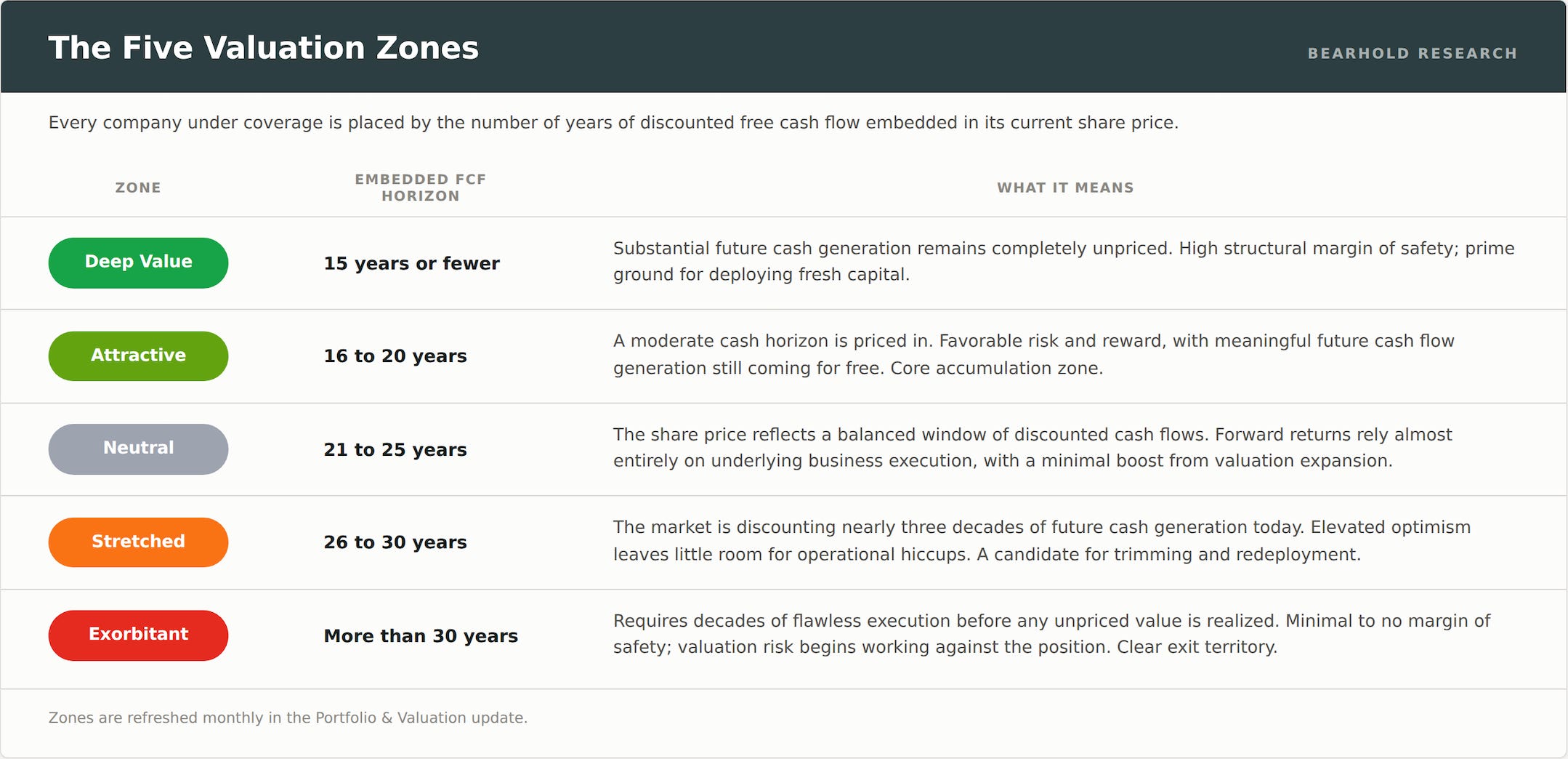
Every covered company receives an updated zone reading at the beginning of each month to reflect moving share prices and incoming financial results.
Why the Zone Matters
Once you know a company’s zone, you know something important; how it is likely to make you money.
There are only two ways an investment return actually happens. The first is the business itself getting more valuable; free cash flow per share grows over time from organic revenue growth, operating leverage, and buybacks shrinking the share count. If free cash flow per share grows 15 percent, you should expect the price to grow at roughly that rate over time, all else equal.
The second is valuation expansion; the market deciding a business deserves a higher premium. This engine only really works when a stock starts out cheap, in the Deep Value or Attractive zones. A stock that is already priced for 30 years of cash flow has little room left for the market to get even more optimistic about it.
This is why the zones matter so much. When you buy in Deep Value or Attractive territory, both engines work in your favor; the underlying business compounds, and valuation expansion adds an extra boost on top. But when you buy in the Stretched or Exorbitant zones, the business has to carry the entire load alone, and the high probability of valuation contraction means the price will actively work against your position rather than helping it.
What I do About it
I hold an approved business for as long as its valuation stays favorable. Once a holding drifts into Stretched or Exorbitant, the margin for error has narrowed and the second return engine is largely spent. At that point, valuation risk starts working against you, so I look to trim or exit and move that capital into another approved name that is still cheap.
There is no predetermined holding period in this approach. A position might be held for a few months if the market re-rates it quickly, or for years if the company just keeps compounding steadily while staying inside an attractive band.
Navigating the Site
With that framework in place, here is what lives behind each tab in the nav bar, and how they connect to each other.
Deep Dives
This is where the fundamental case for a business is made. In each report, I dig into the business model, unit economics, segment margins, reinvestment requirements, and management’s capital allocation record. Every write-up wraps up with a clear verdict; Approved, Watchlist, or Rejected. Nothing ever makes it into the portfolio without a full Deep Dive behind it first, making this the best place to start whenever you want to understand a company under coverage.
Once a company receives an Approved rating, it graduates to the Portfolio & Valuation tab, where I track its valuation zone every single month.
Portfolio & Valuation
This tab is the running monthly record, and it brings together two essential elements:
The model portfolio update tracks the holdings in real time. It details every position added, trimmed, or exited during the month, explains the rationale behind each move, and measures overall performance against the S&P 500 Total Return benchmark.
The valuation update refreshes the embedded years calculation for every company under coverage, not just the ones we currently hold. This allows you to spot approved names that have dipped into Deep Value or Attractive territory and warrant fresh capital, as well as current holdings that have drifted into Stretched or Exorbitant zones and become candidates for trimming.
Together, this tab turns our fundamental research into clear, monthly execution by identifying which quality compounders offer an attractive margin of safety today, and which have become expensive enough to harvest.
Perspectives
This is where my shorter, targeted qualitative essays live. I focus on secular shifts, industry tailwinds, and structural risks shaping the covered companies, such as AI infrastructure demands, regulatory scrutiny, and automation. These are the underlying forces that fundamentally shape the multi-year thesis for a business.
Bearhold Research publishes independent equity research and financial modeling for educational and informational purposes only. Valuation zones represent the mathematical output of finite discounted cash flow models over explicit projection horizons and do not constitute personalized investment advice, endorsements, or trade execution orders. Subscribers are responsible for evaluating their own risk tolerance and conducting independent due diligence. Read full disclosure here.