



Robertet is one of the last independent players of its size in an industry dominated by four corporate giants.
The company creates flavors, fragrances, and the raw natural ingredients used in both segments. It holds a unique competitive advantage because it possesses deep sourcing relationships for rare botanicals built over generations. This is a strategic moat that cannot be replicated through financial capital alone.
While Robertet is small compared to Givaudan, DSM-Firmenich, IFF, and Symrise, it remains the largest player in the world specifically for natural ingredients. However, it is worth mentioning that the stock is thinly traded and the founding family retains majority control. Furthermore, the business carries real agricultural and working capital risks. This report covers both of those dynamics in detail.
The company trades publicly on the Euronext Paris exchange in France.
The author does not hold a position in Robertet Group at the time of publication. This report reflects the author’s personal views and is not investment advice. Investing carries the risk of permanent capital loss. Read full disclosure here.
1. The Business
How the Company Makes Money
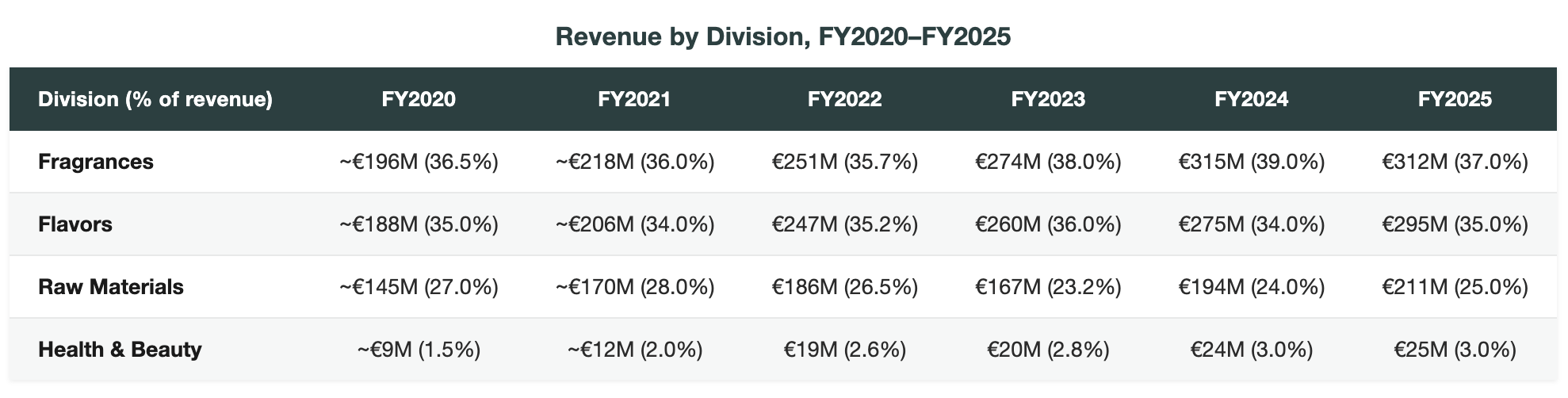
Robertet generates revenue by selling raw natural materials directly through its Raw Materials division, which brings in roughly a quarter of overall sales.
The company also blends these materials with purchased inputs to create finished fragrance and flavor formulations. They sell these formulations to perfume houses, cosmetics brands, and food and beverage companies. Together, the Fragrances and Flavors divisions generate nearly three-quarters of total revenue, split almost evenly between them.
Health and Beauty focuses on active natural ingredients for skincare and personal care. While it is the smallest division at approximately 3% of sales, management is explicitly aiming to grow this segment the fastest.
A significant portion of total revenue is secured under multi-year commercial agreements. According to industry estimates, these contracts often average up to four years. They typically include pricing mechanisms to pass through raw material cost increases to customers. This contractual structure directly shapes how the company margins behave, which will be discussed in details in the financial section below.
History and Origin
The factory operations originally began in Grasse in 1850 as a natural extraction plant named À La Confiance. Paul Robertet acquired this ongoing operation in 1875, giving the company his name and establishing the modern corporate entity. Grasse has served as the historic capital of the French perfume industry since the sixteenth century and Robertet has operated at the absolute center of this region for its entire existence.
The company diversified into food flavors during the 1960s to expand well beyond its traditional fine fragrance customer base. Robertet then listed on the Paris Stock Exchange in 1984 while successfully maintaining family voting control. The business is currently led by the fourth generation of the Maubert family. This legacy represents a continuous operational heritage under family stewardship which explains why the company supplier relationships run exceptionally deep.
Scale and Footprint
Robertet expanded its workforce to 2,746 employees by the end of fiscal year 2025, which is a significant increase from 2,441 workers the previous year. This growth reflects a combination of organic hiring and the launch of new infrastructure, including a manufacturing plant in Indonesia.
The company manages approximately 30 manufacturing facilities and 15 creative centers globally. It distributes products to more than 50 countries and serves over 5,800 clients, including prominent luxury and consumer brands such as Chanel, Dior, L’Oréal, L’Occitane, and Burberry.
The business carries no material customer concentration risk. No single client accounts for more than 4% of total revenue, and the top 20 clients combined generate roughly 35% of overall sales. However, because Robertet reports its financials in Euros while billing about 40% of its revenue in US dollars, shifting currency translation values continue to have a noticeable impact on recent corporate results.
2. The Moat
Robertet’s competitive position relies on three reinforcing pillars as follows:
The first pillar is exclusive access to rare natural raw materials through relationships that took decades to build and cannot be easily replicated.
Robertet sources patchouli from Indonesia, rose from Bulgaria, Turkey, and France, and vetiver from Haiti and India. It also sources sandalwood from New Caledonia and Australia through a dedicated joint venture, and vanilla from Madagascar through two additional joint ventures.
Roughly 80% of its natural material purchases run under contracts of three years or longer, pulling from a vast network supplying over 1,700 botanical extracts across 60 countries. In several of these critical raw material categories, Robertet already controls more than 30% of the global supply.
The second pillar is a sophisticated traceability infrastructure that has become a genuine switching cost for clients. Robertet maintains 67 certified supply chains and holds a prestigious EcoVadis Platinum rating. As global brand owners face growing pressure to document exactly where their ingredients originate, this precise documentation becomes an asset that a customer cannot easily replicate by switching to a less integrated supplier.
The third pillar is the contract structure itself. With a significant portion of revenue protected under multi-year agreements that include raw material cost pass-through provisions, margins remain highly insulated. Because reformulating an established luxury fragrance or consumer flavor is an expensive and risky decision for a brand owner, the practical switching cost for existing customers remains exceptionally high even without formal exclusivity clauses.
3. Financial Performance
Revenue Growth Dynamics
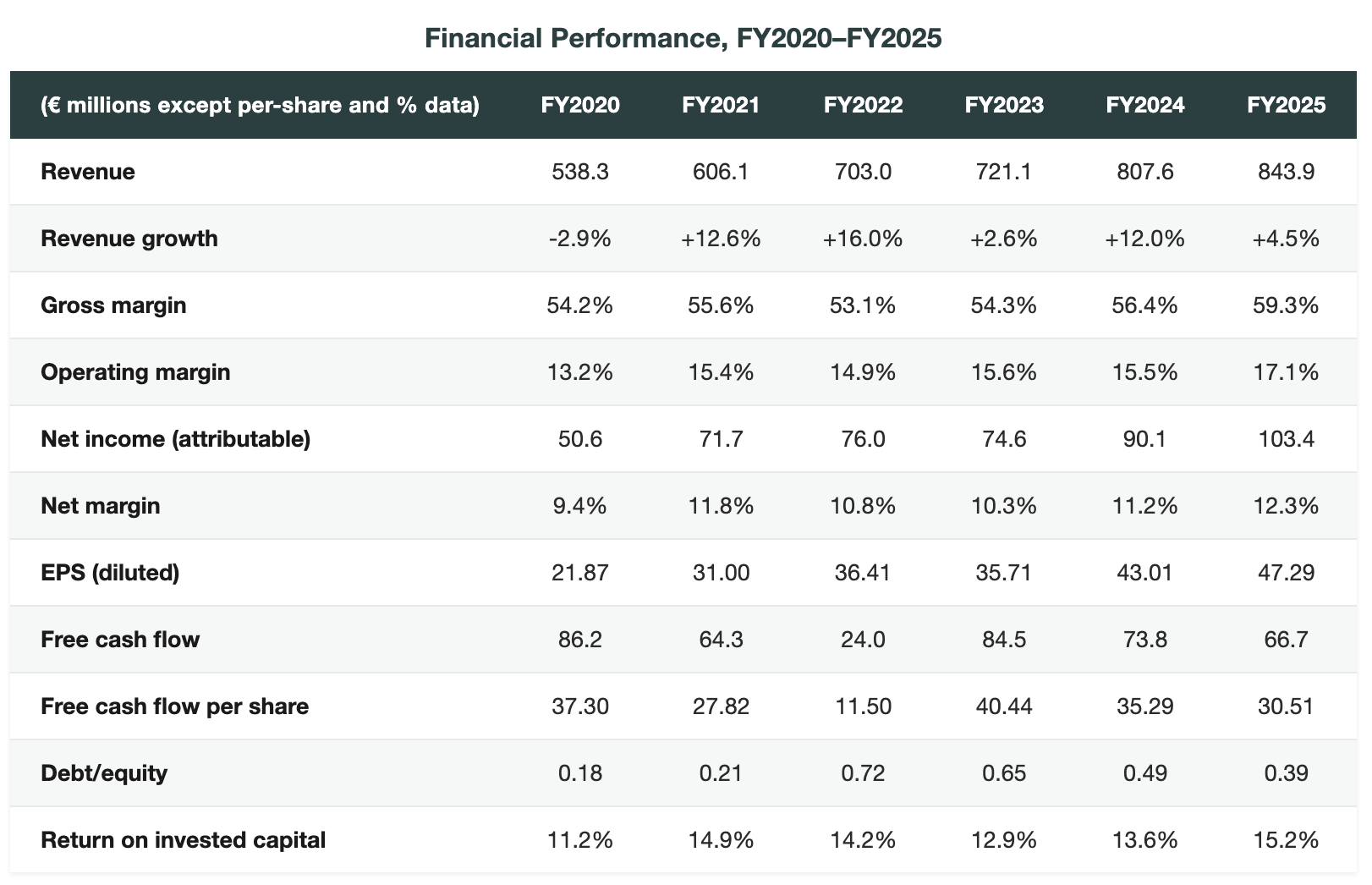
Revenue grew by 57% from €538.3 million to €843.9 million over the period under study. This growth reflects uneven performance across separate operating divisions instead of a single smooth trend, a dynamic that becomes clearly visible when looking at recent fiscal years.
In fiscal 2025, Raw Materials acted as the primary growth driver by expanding 12.4% organically, while Fragrances lagged behind at 2.1% growth. That operational pattern reversed sharply in the first half of 2026. Raw Materials organic growth contracted by roughly 6% while the Fragrances division accelerated to over 12% organic growth. Consequently, overall group organic growth decelerated from 7.6% for the full year of 2025 down to 2.8% in the first half of 2026.
This type of rotation is normal for a business where the Raw Materials division relies heavily on variable agricultural harvests and volatile commodity pricing. These input costs do not move in the same direction as consumer demand for finished fragrances and flavors.
The slowdown in the first half of 2026 reflects management caution alongside persistent cost pressures from petroleum-derivative materials, which the company intends to offset through ongoing customer price negotiations. The long-term corporate target of roughly 5% average annual organic growth through 2030 assumes these divisional swings will balance out over time. The performance pattern seen across 2025 and 2026 remains entirely consistent with those historical averages.
Net Margin and Earnings Per Share
Net margin has risen every year since 2022 and reached a record 12.3% in 2025. Diluted earnings per share more than doubled over the same stretch, climbing from €21.87 to €49.34. This represents an average annual growth rate of roughly 16.7%. These two metrics move closely together because they share the same underlying business drivers.
The first driver is a product mix shift toward higher-margin categories. Raw Materials commands strong margins through proprietary extraction processes. Similarly, prestige and niche perfumery within the Fragrances division commands higher prices than mass-market formulations. Both areas have been growing faster than the group average.
The second driver is operating leverage. Total revenue grew 57% from 2020 to 2025 while the operating margin expanded from 13.2% to 17.1%. This expansion proves that fixed overhead costs are being spread across a much larger revenue base.
The third driver is manufacturing efficiency. The €25 million automated mixing plant at Plan-de-Grasse automates more than 80% of the compounding process. This efficiency directly cuts labor costs per kilogram and minimizes batch waste.
The fourth driver is a pricing catch-up mechanism. Around half of Robertet contracts include cost pass-through clauses that adjust with a lag. Sourcing input costs spiked through 2021 and 2022 before client pricing caught up. By 2024 and 2025, selling prices adjusted higher while agricultural, freight, and energy costs stabilized, which widened the spread between what Robertet charges and what it pays.
The fifth driver is lower financing costs. As total corporate debt decreased from its 2022 peak, annual interest expenses fell alongside it.
The final margin driver is the resolution of the DSM-Firmenich situation. The legal and advisory costs tied to managing that ownership overhang disappeared once the French Financial Markets Authority approved the new shareholder agreement in February 2025.
Earnings per share also benefited from a smaller overall share count. The 2022 public tender buyback program repurchased shares at €885 each for a total envelope of roughly €200 million. Robertet has been systematically cancelling these treasury shares ever since. As a result, the diluted share count fell from 2.31 million in 2020 down to approximately 2.1 million by 2025, allowing identical earnings growth to be divided across fewer total shares.
Free cash flow per share
Free cash flow per share has experienced much wider swings than earnings per share over this five year period. The metric shifted from a low of €11.50 in 2022 to a peak of €40.44 the following year and currently sits at €30.51. This trajectory highlights that the business does not follow a simple linear upward trend.
The primary driver behind this volatility is the inventory cycle. Robertet operates with natural botanicals tied to annual agricultural harvests not synthetic chemicals that can be ordered on demand. Consequently, the company must hold inventory for an average of 240 to 260 days. It buys and stores raw materials well ahead of the growing season to guarantee uninterrupted client supply lines.
When agricultural prices surge and global supply chains tighten, Robertet proactively increases its forward purchasing to insulate its inventory. This strategic decision routinely ties up substantial working capital and temporarily depresses cash flow even when top line revenue continues to grow. These operational decisions show up directly in the inventory days on hand metrics, which fluctuate between roughly 240 days and 260 days depending on the crop cycle. As global input costs and ocean freight rates normalize over subsequent harvests, that tied up working capital unwinds, inventory days on hand contract back toward their historical averages, and cash flow recovers.
Capital expenditures introduce an additional layer of volatility on top of this inventory cycle. Robertet typically targets spending between 5% and 7% of annual sales on its underlying industrial base. Specific large scale projects occasionally push expenditure above those baseline averages. Recent examples include the major automated facility upgrade at Plan-de-Grasse, the construction of the new manufacturing plant in Indonesia, and capacity additions across both the United States and Mexico.
This cash flow pattern is a normal characteristic of an industrial business built on natural crop sourcing and is not a sign of operational weakness. Operating cash flow before working capital movements rests at a structurally higher baseline today than it did five years ago. For this reason, free cash flow per share should always be evaluated across a multi-year average.
Finally, Robertet carries no material stock based compensation, meaning its free cash flow performance represents clean cash generation that is completely free from non-cash accounting adjustments.
4. Growth Levers and Addressable Market
A) The Structural Shift Toward Naturals
Demand for naturally derived ingredients in cosmetics, food, and personal care has grown steadily for a decade. This shift is driven by evolving consumer preferences and increasing regulatory pressure on synthetic alternatives in certain categories. Robertet is positioned to capture this trend better than almost any other scaled player because its entire sourcing infrastructure was built around natural ingredients from the very beginning.
B) Developing Market Expansion
Management has targeted ten specific high-growth countries to deliver more than half of the company incremental growth through 2030. The geographic data already demonstrates that this strategy is working. Latin America grew organically at 32.8% and Asia grew at 13.3% in fiscal 2025. Both of these figures are far ahead of the low single digit growth tracked in the more mature European and North American markets.
C) Health and Beauty as an Adjacent Category
Health and Beauty currently generates around 3% of total sales. Management targets roughly doubling this market share by 2030. This business line is early stage and starts from a small baseline, meaning it has not yet demonstrated a proven track record of scaling the way the larger divisions have. However, active natural ingredients for skincare and personal care sit naturally alongside Robertet existing sourcing capabilities. This initiative does not require establishing new supplier relationships because it simply layers new formulations and commercial capabilities on top of existing operations.
D) Green Extraction as a Margin and Capacity Lever
Robertet investment in green extraction technology, developed partly through its Phasex acquisition, represents a long-term bet on lower cost and lower impact processing methods. This technology supports the exact same positive margin trajectory already visible in corporate profitability data over the past three years. Crucially, it achieves this improvement without requiring new raw material sourcing networks since it changes how existing inputs are processed instead of changing what is sourced.
What the 2030 Targets Tell us
Robertet’s own Seed to Success 2030 plan targets €1.1 to €1.2 billion in revenue, an operating margin above 20%, and a return on capital employed of 16%. This return is a step up from roughly 14% to 15% today. Every major flavor and fragrance company is chasing natural ingredients and expanding into emerging markets, while these broad strategic goals are common across the industry, Robertet possesses a distinct advantage in its historical sourcing network. Competitors relying on synthetic production methods cannot easily match these long-term agricultural relationships.
Given where growth is already showing up in the divisional and regional breakdown above, the 2030 targets look achievable.
5. Management
Leadership and Tenure
Robertet is chaired by Philippe Maubert, representing the fourth generation of the family to lead the business since the era of Paul Robertet. Chief Executive Jérôme Bruhat joined the group from L’Oréal following a thirty year tenure there, which included roles as global brand president of Maybelline and managing director positions in Germany and Japan. He brings extensive large-company commercial and operational experience into a firm historically managed almost entirely by the founding family. Christophe and Julien Maubert continue to lead individual divisions, which keeps day to day operating knowledge inside the family line even as the top executive role has been opened to
Shareholder Matrix and Voting Power
The Maubert family controls approximately 38% of Robertet capital and roughly 63% of voting rights by combining its holding company and direct family positions. Long term share holdings earn double voting rights, which helps boost this final voting figure.
Fonds Stratégique de Participations and Peugeot Invest each hold about 7.1% of capital following their November 2024 purchase of DSM-Firmenich exiting stake. DSM-Firmenich subsequently sold its final remaining 1% position to complete its total exit from the business.
Treasury shares held by the company itself account for another 9.2% of capital with no attached voting rights. This allocation leaves a free float of somewhere around 37% of capital available to trade openly on the market. This structure represents a highly aligned corporate framework for a European small cap equity. The executives running the business alongside their long term institutional partners collectively command a large majority of the voting power.
Capital Allocation
Robertet capital allocation follows four consistent priorities under family ownership as follows:
First, the group targets industrial reinvestment of 5% to 7% of sales most years into automation, new regional capacity, and extraction technology.
Second, leadership pursues small, targeted bolt-on acquisitions instead of transformative mergers.
Third, the business pays a steadily growing dividend, which has expanded from €5.60 per share in 2020 to €12.00 for FY2025 while keeping a stable payout ratio within the 23% to 26% range throughout.
Finally, management uses debt opportunistically for large capital returns, such as the 2022 buyback, and then pays that debt down before adding more obligations.
On the reinvestment side, spending has gone toward automation projects like the Plan-de-Grasse facility, new regional compounding capacity closer to end markets, and clean process technology. Examples include the supercritical CO2 extraction capability picked up through the 2024 acquisition of Phasex. Robertet avoids purchasing farmland directly. It works instead through long-term supply agreements and minority joint ventures with growers and distillers. This structure keeps the balance sheet focused on extraction and formulation instead of taking on direct agricultural exposure.
The bolt-on acquisitions have each targeted a specific capability or geography without adding meaningful debt or diluting family control. The core recent transactions include the following executions.
In 2026, Robertet made a strategic investment in Aethera Biotech to establish a center of excellence for plant-based biotechnology in cosmetics.
In 2024, the company bought Phasex in the United States to secure advanced extraction technology.
In 2023, the group took over Sonarome in India to accelerate market entry in South Asia.
In 2023, the firm acquired Aroma Esencial in Spain to secure specialized citrus and labdanum sourcing infrastructure.
In 2022, the business bought Omega Ingredients in the United Kingdom to add key natural food flavorings.
The dividend has tracked earnings growth closely. The 2022 buyback, which was the other major capital return, was funded with debt and worked back down through ordinary deleveraging.
Robertet continues to cancel the treasury shares it holds. This practice lowers the overall share count over time and adds to earnings per share growth on top of the underlying operating drivers. This framework is not an aggressive capital allocation strategy, but it has kept the balance sheet clean enough to absorb large working capital swings without needing external capital.
6. Valuation
Growth Engines
The future return on Robertet stock comes from two primary engines, which are growth in free cash flow per share and a potential valuation re-rating. Both are explained below:
Engine 1, Fundamentals
The first engine relies entirely on the business performance. Free cash flow per share scales upward over time through revenue expansion, margin improvement, and a smaller share count achieved via stock buybacks
For Robertet, I assume free cash flow per share growth averaging 10% over the first decade of the projection period. The drivers supporting this estimate match the variables discussed in the financial analysis. These include a continuing product mix shift toward Raw Materials, prestige Fragrances, and Health & Beauty. The business also benefits from manufacturing efficiencies at the automated Plan-de-Grasse project alongside developing market expansion across Latin America and Asia.
Buybacks add a further per-share effect. The diluted share count has already fallen from 2.31 million to around 2.1 million over the past five years, and continued cancellation of treasury shares should keep contributing on top of underlying earnings growth.
Given how cyclical free cash flow has actually been over the past five years, swinging from €11.50 to €40.44 per share depending on where the harvest and inventory cycle happens to sit in a given year, I use EPS growth as the proxy for the fundamental engine in the model, not the free cash flow line itself.
Engine 2, Valuation Re-Rating
At the current price of around €797, the investor is paying for everything this business will earn over roughly the next 18 years, in today’s money. Everything it earns beyond that point comes to the investor at no additional cost. The fewer the embedded years, the more of the future the investor receives without paying for it.
At 18 embedded years, the price sits in the Attractive zone on my own valuation scale. I expect future returns to come from both engines, as the underlying business compounds, and valuation expansion at this zone adds an extra boost on top.
Learn how the valuation zones work in detail here
The current zone is tracked and updated in the monthly Portfolio & Valuation update.
7. Risks
Agricultural Sourcing and Working Capital Cyclicality
Robertet relies heavily on botanical sourcing from a small number of specific countries. These dependencies include Madagascar for vanilla, Haiti for vetiver, and Indonesia for patchouli. This focus means that weather extremes, crop failure, or geopolitical disruption in any of these regions can severely damage specific product lines. A synthetic chemistry competitor would not experience these vulnerabilities.
This risk is a practical reality for the business. It serves as the exact mechanism behind the sharp free cash flow swings covered in the financial analysis. A bad year for input costs forces the company to spend cash to secure inventory, which compresses cash generation immediately even while accounting earnings hold up.
The long inventory cycle of 240 to 260 days supports this natural sourcing strategy but introduces risk by tying up significant working capital. This structure delays the point at which a bad harvest year actually shows up in the cash flow statements.
Ownership Concentration and Trading Liquidity
The Maubert family and its aligned institutional partners control roughly 63% of total voting rights. This concentration leaves the tradable free float closer to 37% of outstanding shares. Consequently, the daily trading volume on the Paris exchange remains very thin compared to large cap companies.
This dynamic does not constitute a direct business risk because it does not affect Robertet underlying earnings power. It represents a practical investment risk for managing position sizes alongside transaction timing. An investor cannot move quickly into or out of a large position in this stock without causing significant price distortion.
It is also important to note the implications of concentrated family control. While this dynamic has produced a genuinely well run business over generations, minority shareholders remain highly dependent on the continued good judgment of the founding family.
8. The Verdict
Robertet has spent nearly 150 years of continuous operational heritage building an asset that cannot be matched through capital alone. This asset is direct, multi generational access to the rare botanicals required for natural fragrances and flavors.
The investment case becomes compelling now because a previously tangled ownership structure has cleared just as a concrete growth runway opens up. The total exit of DSM-Firmenich from the cap table removed a direct competitor from the shareholder base. This resolution left the Maubert family and its long-term institutional partners firmly in control, delivering the cleanest ownership structure this business has seen in years.
From this foundation, the growth drivers are already demonstrating measurable momentum.
Latin America and Asia are expanding at double digit rates, and Health and Beauty is scaling from a small baseline with a clear path to double its revenue share by 2030.
Furthermore, the automation efficiencies and pricing gains that expanded recent net margins to 12.3% have additional room to run as new production capacity in Indonesia continues to ramp up.
These strengths must be balanced against three structural realities. Investors must accept a thinly traded stock with an open free float of only 37%, which makes entering or exiting large positions a slow process. Financial performance will also remain tied to a long inventory cycle of 240 to 260 days, introducing inevitable free cash flow swings based entirely on crop harvest patterns and volatile raw material pricing. Finally, corporate governance relies on a concentrated voting framework where minority shareholders depend on the continued execution capability of a single founding family.
For long term capital, these structural risks represent a fair trade. Robertet provides a clean balance sheet, high returns on invested capital, and a unique natural raw material monopoly. It offers rare exposure to global consumer luxury trends without paying the extreme valuation premiums typically demanded by the broader market. Robertet is Approved.