


When I first started analyzing how generative artificial intelligence would disrupt Hollywood, my initial conclusion was bleak for Netflix.
The thesis seemed obvious; filmmaking has spent a century protected by a massive capital moat. If you wanted to build an exploding starship, stage a medieval battle, or render an alien planet, you needed a legacy studio balance sheet, hundreds of specialized digital artists, and a $150 million to $200 million check. Netflix mastered this game by spending roughly $20 billion a year on content, amortizing that astronomical bill across more than 325 million paying subscribers.
If generative AI collapses production costs by 70% to 90%, that capital moat evaporates. Anyone with a high-end laptop, an aesthetic eye, and a subscription to next-generation diffusion models will be able to synthesize Hollywood-grade visuals for a fraction of the cost. If thousands of indie creators can produce blockbuster hits from their bedrooms, Netflix suddenly looks like an asset-heavy legacy manufacturer trapped with high overhead, while open platforms like YouTube clean up.
I spent the past few weeks stress-testing that thesis against the hard data, looking at ten years of television viewing trends, generational attention shifts, the brutal economics of live sports, and Netflix’s internal balance sheet.
What I realized is that the prevailing bear case misunderstands the physics of platform economics.
The democratization of filmmaking will dismantle the traditional studio system, but Netflix will not be its casualty. In fact, if you follow the structural math, Netflix is set up to emerge as a massive net winner, not by remaining a traditional film factory, but by transforming into the high-margin, editorial gateway for an age drowned in synthetic noise.
Here is how I anticipate the next decade will actually play out.
1. The Production Deflation Shock and the Hybrid Workaround
To understand what is coming, I look at what is already happening inside physical production.
Studio mogul Tyler Perry made headlines when he halted a planned $800 million, 12-soundstage expansion of his Atlanta studio after seeing the rapid maturity of video generation engines. Why pour hundreds of millions of dollars into concrete backlots and physical lighting rigs when neural rendering can generate photorealistic virtual environments on the fly?
I am already seeing this on screen. In the Argentine science-fiction series The Eternaut, Netflix used generative visual effects to render complex urban destruction scenes ten times faster than standard VFX pipelines, completing sequences that would have been budgetarily impossible under legacy methods. On their docuseries The American Experiment, they synthesized 17 minutes of complex visual sequences in half the usual time and at half the projected cost. In 2026 alone, Netflix reported that generative AI tooling touched approximately 300 active production titles.
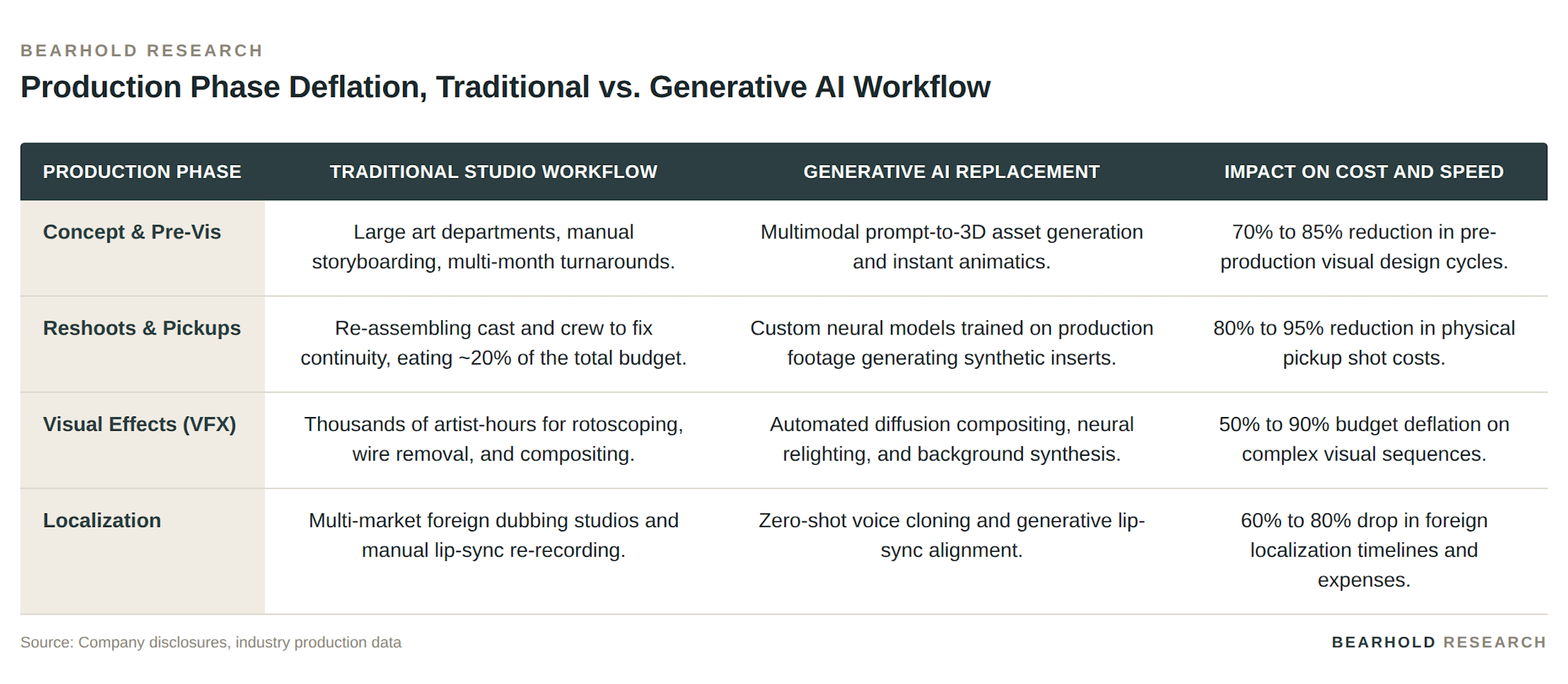
Early critics argued that studios would never be able to copyright AI films because the US Copyright Office and federal rulings (like Thaler v. Perlmutter) established that purely machine-generated outputs cannot be copyrighted. But that argument assumes creators are going to publish raw text-to-video prompts.
They won’t. The industry is converging on a hybrid workflow.
Filmmakers write human scripts, direct real human actors, and capture authentic emotional performances on minimal stages, then deploy AI tools to handle background synthesis, digital costumes, world-building, and compositing. Because the human expressive input remains the driving creative force, the final product easily clears the copyright threshold.
Furthermore, with new legal frameworks established by SAG-AFTRA and state laws like California’s AB 2602 and AB 1836 protecting digital replicas, prominent actors are turning their likenesses into passive revenue streams. A star can license their digital twin to appear in an indie sci-fi movie without ever setting foot on a soundstage.
This means the barrier to creating a visually stunning, legally protected, star-studded motion picture is collapsing toward zero.
Generative AI does not spell the end of copyrighted premium cinema; it democratizes the craft through hybrid human-machine pipelines, transforming filmmaking from a capital-heavy manufacturing process into scalable software. But this reality immediately sparks the central bear thesis; if anyone can make a Hollywood movie on a micro-budget, why would an audience pay a subscription to an expensive production house when asset-light aggregators like Uber or YouTube dominate digital platforms? That brings me directly to the fundamental fallacy of comparing cinema to taxicabs.
2. The Uber Fallacy and Why Aggregation Beats Production
When I evaluate this cost collapse, people often bring up the transportation analogy; If filmmaking becomes cheap, why would Netflix spend billions manufacturing movies? Uber doesn’t manufacture cars; it’s an asset-light aggregator. Netflix will lose to platforms like YouTube that don’t pay for content.
It’s an intuitive analogy, but it misses a fundamental economic truth that rides are fungible; stories are not.
If an Uber shows up at your curb, you don’t care whether it was assembled in Detroit or Tokyo, nor do you care about the personal vision of the engineer who built the engine. You just want to get from Point A to Point B. Transportation is an interchangeable commodity.
Art, narrative, and culture are the exact opposite. Nobody logs onto a television to consume “generic moving-image file #482.” They want Squid Game, Stranger Things, or a deeply resonant narrative that their friends are talking about.
Here is where Clayton Christensen’s Law of Conservation of Attractive Profits comes into play. The law states that when a product’s previously scarce, proprietary stage becomes modularized and commoditized, the attractive profits shift to an adjacent, proprietary stage.
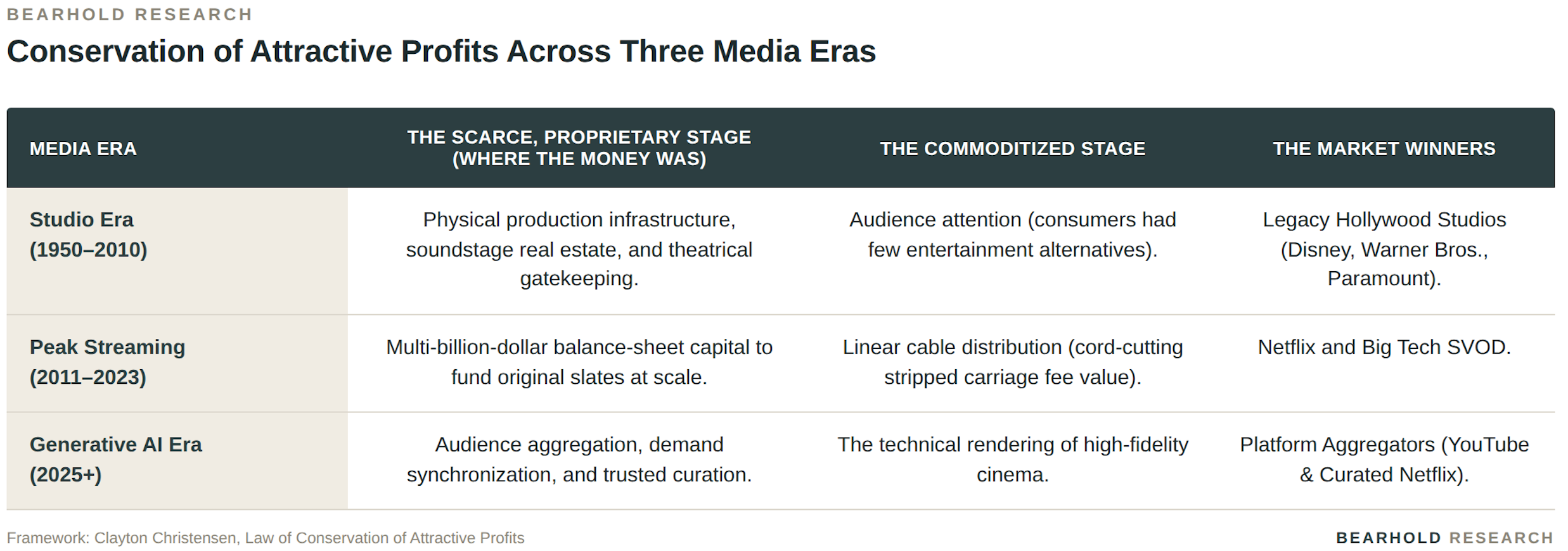
When the mechanical act of generating high-end cinema becomes free, high-end cinema ceases to be scarce. What becomes scarce is human attention and editorial trust.
If 100,000 independent creators make great-looking movies next year, open platforms like YouTube will be flooded with an ocean of content. But an independent creator uploading an AI masterpiece to the web faces a massive bottleneck; they have an mp4 file, but no audience.
Netflix doesn’t just sell video playback; it commands an audience of over 325 million paying households across 190 countries, backed by a recommendation algorithm estimated to be worth more than $1 billion annually. When Netflix drops a title, it can synchronize global watercooler attention, directing 50 million to 100 million people to a single piece of intellectual property in a single weekend.
Creators who own low-cost AI movies won’t build their own subscription apps; they will line up at Netflix’s door desperate for distribution, exactly like indie developers selling games on Steam or authors publishing on Amazon.
When production costs fall toward zero, economic power does not vanish, it migrates downstream to the platform that controls audience attention, billing relationships, and discovery curation. Aggregation, not manufacturing, becomes the high-margin tollbooth. Yet establishing that aggregation wins answers only half the puzzle. If aggregators capture the value of infinite content, who is actually winning the battle for the living room screen right now? Looking at ten years of television viewing data reveals that while Netflix has built a powerful curation engine, an open aggregator has been staging a massive, quiet invasion of our living rooms.
3. The 10-Year Screen Time War
To see how audience attention is actually moving, I pulled ten years of Nielsen living room television screen data:
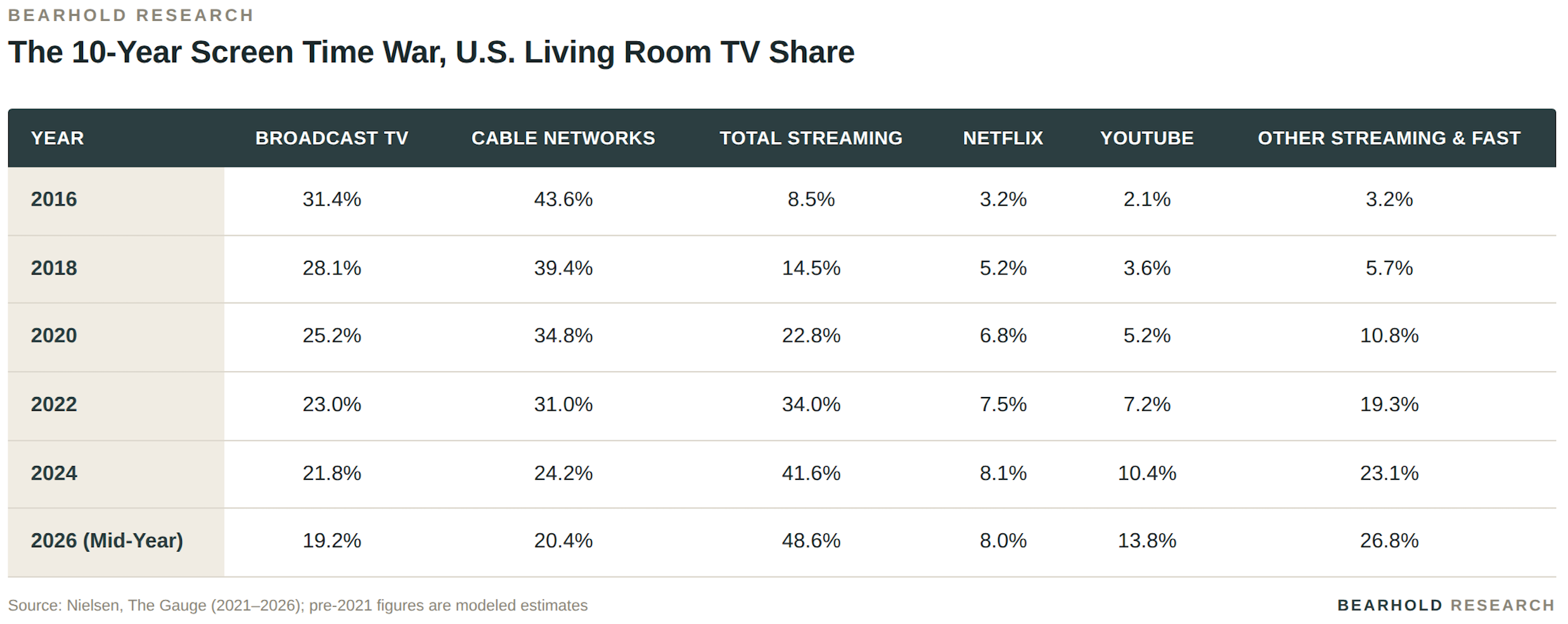
Two massive trends stand out:
The Linear Collapse: Cable has been cut in half, plunging from 43.6% down to 20.4%. In May 2025, streaming reached a historic watershed when its total share (44.8%) surpassed the combined viewing volume of broadcast and cable (44.2%) for the first time.
The YouTube Ascent: YouTube grew its living room television viewing volume by over 120% between 2021 and 2025, reaching 13.8% of all US television viewing by mid-2026, firmly establishing itself as the single largest media distributor on connected TVs.
Meanwhile, Netflix’s television watch time leveled off, stabilizing between 7.5% and 9.0%.
Why did Netflix hit this plateau while YouTube kept climbing? Because Netflix is built around high-involvement narrative programming. You sit down to watch a 10-episode drama with your full attention. Once you finish the season, you take a break. YouTube, by contrast, captures ambient screen time, podcasts, gaming streams, background music, tutorials, and short creator clips running for hours while people cook, work, or browse their phones.
YouTube operates with zero balance-sheet cost of goods sold on its content, taking an automated cut of programmatic advertising from decentralized creator uploads. It is the ultimate asset-light aggregator.
If Netflix tried to beat YouTube at the volume game, it would lose. But Netflix isn’t trying to be YouTube. It’s building something completely different.
The decennial television screen data confirms that while YouTube has captured the war for ambient, continuous daily minutes, Netflix has stabilized a high-value, highly concentrated share of intentional living room viewing. Its watch-time plateau is not a structural failure; it reflects the natural saturation point of high-involvement narrative entertainment. Facing this plateau while watching YouTube capture ambient viewing hours, the intuitive corporate move for Netflix would be to chase the last remaining format that guarantees massive, live, synchronized living room viewing; regular-season sports. But taking that bait would walk Netflix straight into a balance-sheet catastrophe.
4. The Live Sports Trap
If scripted entertainment is deflating, the natural instinct for a streaming platform is to pivot into live sports. Sports are the ultimate anti-AI asset; an algorithm cannot synthesize the live, real-time emotional stakes of an NFL game.
However, there is an economic poison pill in live sports called the Winner’s Curse.
Because sports rights auctions are fiercely contested, the winning bidder almost always overpays relative to the direct economic returns of the broadcast. Alphabet can comfortably absorb an estimated $1 billion annual loss on NFL Sunday Ticket (paying roughly $2 billion a year) because it treats sports as a loss leader to drive Android TV adoption, YouTube TV subscriptions, and search-intent advertising across its broader ecosystem. Amazon does the same with Thursday Night Football to drive Prime retail conversions.
Netflix cannot afford to run multi-billion-dollar loss leaders. It sells entertainment, not cloud servers or e-commerce delivery.
Netflix Co-CEO Ted Sarandos laid out the company’s financial philosophy clearly: “We’re not anti-sports, we’re pro-profit. We’ve not seen a profit path to renting big sports.” He added that while Big Tech rivals use sports as expensive marketing expenses, Netflix demands a direct return on its investments.
Instead of spending $10 billion to license a full season of regular-season games, Netflix developed a distinct playbook:
Eventized Cultural Pop-Ups: They buy single-day global holidays. Broadcasting two exclusive NFL games on Christmas Day in 2024 delivered the biggest day in streaming history, capturing massive concurrent live audiences without locking the company into multi-billion-dollar annual rights commitments.
Year-Round Entertainment Sports: Rather than paying legacy leagues, they paid $5 billion over ten years for WWE Raw, locking in 52 weeks of live, episodic sports-entertainment programming with zero off-season, at a predictable, fixed annual cost.
The “Drive to Survive” Strategy: They dominate the sports conversation by producing behind-the-scenes narrative docuseries across Formula 1, golf, and tennis, capturing the emotional engagement of the sports audience at standard entertainment production margins without paying broadcast fees.
Netflix is deliberately dodging the sports rights trap, refusing to sacrifice its operating margins to subsidize legacy athletic leagues.
By treating live sports as occasional, high-impact cultural spectacles rather than an expensive, year-round utility, Netflix protects its operating margins from the destructive “Winner’s Curse” that tech giants with secondary balance sheets can afford to subsidize. Yet even if Netflix avoids bleeding capital into sports and commands high-margin narrative aggregation, an even larger existential question looms over the entire medium; What happens if the upcoming generation simply stops caring about passive narrative stories altogether?
5. Are Movies and TV Becoming a “Legacy Medium”?
This brings me to the deeper cultural threat; What if younger audiences simply don’t care about movies and TV anymore?
The data on younger cohorts shows a noticeable generational shift. According to Deloitte’s digital media research, 90% of Gen Z and 84% of Millennials identify as active gamers. Among Generation Alpha, 43% spend more than three hours a day playing interactive games like Roblox and Fortnite, surpassing the 41% who watch television.
The macroeconomic capital deployment confirms this behavioral shift. The global video game software market generated $188.8 billion in 2025. The global theatrical box office generated just $32.8 billion, remaining 22% below its 2019 pre-pandemic peak. Interactive gaming is now nearly six times the size of theatrical cinema.
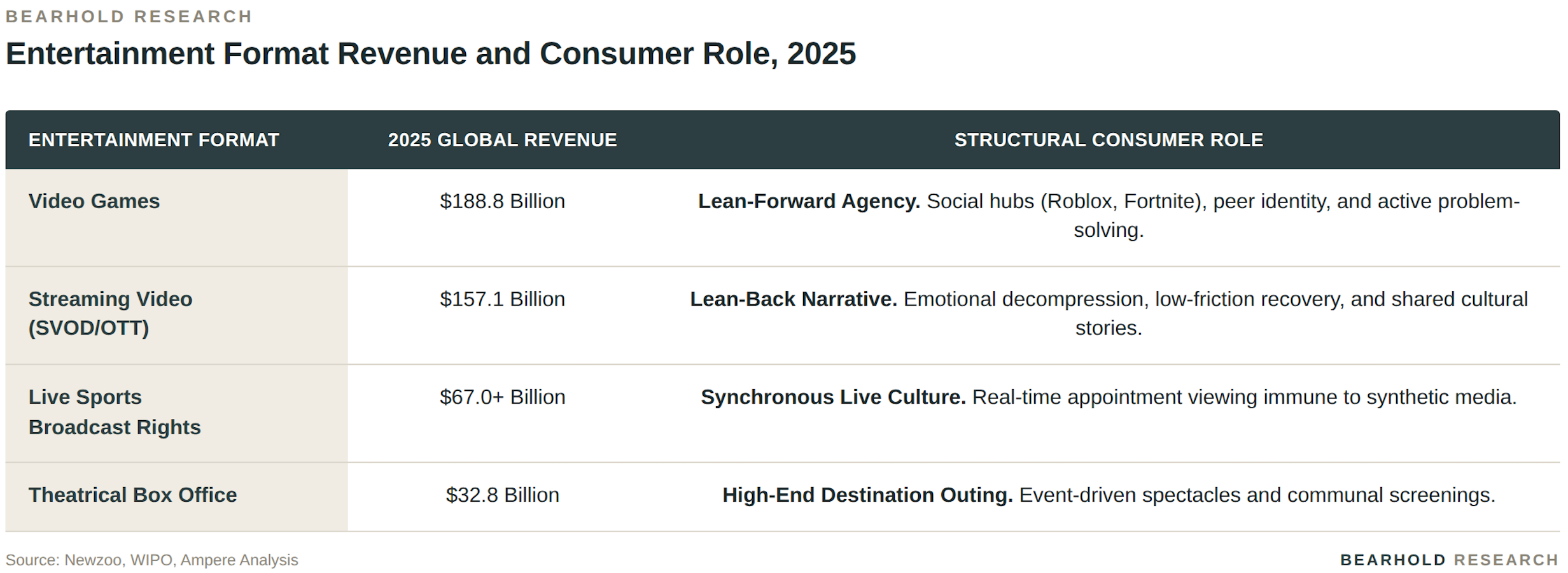
When I calculate the historical odds of media succession, looking at how the novel was displaced by radio, and how radio drama surrendered to television, I see a high probability that traditional passive cinema and TV become a legacy medium by 2040.
By “legacy medium,” I don’t mean that movies will disappear. The theater didn’t die when cinema arrived, and the printed novel didn’t die when television took over the living room. But they ceased to be the dominant engine of mass human attention. They became elevated, high-prestige, specialized formats.
This is supported by human biology. Lean-forward interactive gaming demands cognitive executive function, motor coordination, and real-time decision-making. It is stimulating, but it causes cognitive fatigue.
The human nervous system has a biological need for the lean-back state, a low-friction mode that requires zero motor control, aids parasympathetic recovery, and fulfills our evolutionary drive for narrative empathy through structured, human-told stories. When people conclude an exhausting eight-hour workday or academic session, they regularly choose to turn off the interactive headset or controller and sink into the couch for an authored narrative.
Movies and television will almost certainly transition into a legacy medium over the next fifteen years, conceding raw youth hours to interactive worlds, but stabilizing as an elevated, high-prestige format anchored by the biological human need for passive narrative recovery and empathetic storytelling. Recognizing that passive video will become an elevated legacy medium naturally leads to the ultimate valuation panic; If cinema takes the path of the theater and the novel, does that mean Netflix will witness a severe decline in subscribers, or even an outright collapse? Looking closely at the demographic and financial numbers clarifies the picture.
6. Why Netflix Won’t Suffer a Subscriber Collapse
If movies and TV are transitioning into an elevated legacy medium, does that mean Netflix will witness a severe decline in subscribers, or even an outright collapse of its paying base?
Some analysts argue that as Gen Alpha matures, Netflix will inevitably witness a sharp decline in subscribers, or even an outright collapse of its member base. But looking at the actual demographic mechanics shows why that narrative doesn’t hold up:
The Core Audience is Young: Unlike legacy cable television, whose median viewer is over 55 to 60 years old, Netflix’s user base is concentrated in younger generations. Millennials make up 41% of its audience, and Gen Z accounts for 34%. Three-quarters of its subscribers are under 45, and 75% of all US adults aged 18 to 34 hold a Netflix subscription.
The Interwoven Consumer: The 90% of Gen Z consumers who play video games haven’t stopped watching television. They blend their media diet: they play Fortnite in the afternoon, watch YouTube commentary on their phone, and stream Netflix with their partner in the evening.
Global and Multi-Generational Moats: Roughly 69% of Netflix’s subscribers live outside the United States and Canada, and 34% of member households live with school-aged children. Even if a teenager spends their night gaming, parents and older family members continue to stream dramas, comedies, and licensed films.
The Billing Barrier: Cheaper production will not create 5,000 independent streaming apps. The average consumer is willing to manage only three to four paid video subscriptions simultaneously. Consumers already face subscription fatigue. Independent AI creators will not build their own subscription gateways; they will license their content to aggregate platforms.
To show how I anticipate this balancing out, I modeled three ten-year sensitivity scenarios for Netflix through 2036:
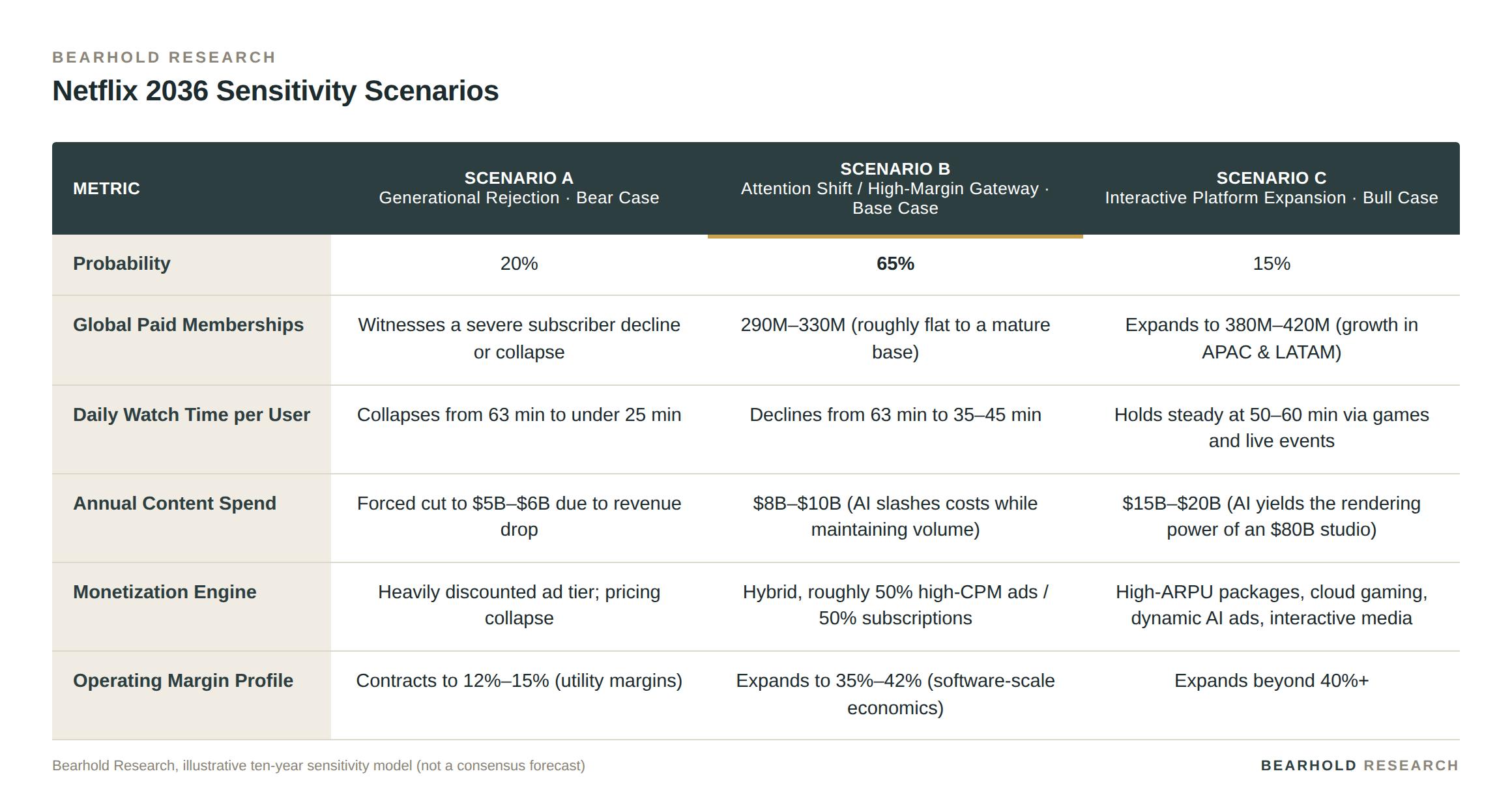
The base case shows a clear divergence as individual daily viewing minutes on Netflix will likely decline, but total paid subscriptions and overall profitability will hold steady or expand.
A subscriber might spend 40 minutes watching Netflix instead of 63 minutes because they dedicated an hour to gaming or social feeds. But they don’t cancel their subscription.
With Netflix’s ad-supported tier reaching more than 250 million monthly active viewers, the platform has lowered the barrier to keeping an account active. In 2025, Netflix pulled in $45.18 billion in revenue (up 15.8% year-over-year) and generated an operating margin of 29.5%. Its ad revenue crossed $1.5 billion in 2025 and is projected to double to roughly $3 billion in 2026.
The demographic and financial data demonstrates that a reduction in daily viewing minutes does not translate into a collapse of paying households. By harnessing cheaper AI production, scaling its ad tier, and serving as an essential multi-generational domestic utility, Netflix converts lower per-user engagement into higher operating margins. But a bullish macroeconomic thesis is only as good as its real-world execution. Before delivering a final verdict, I have to ask; if this thesis breaks down, where are the structural fault lines? That brings me directly to the pre-mortem.
7. The Pre-Mortem, What Could Break in Execution?
Whenever an investment or strategic thesis looks overwhelmingly compelling, intellectual discipline requires performing a pre-mortem. If my bullish projection fails over the next five to ten years, it won’t be because generative AI didn’t work, it will be because management stumbled in execution.
I see four distinct operational pitfalls that could derail Netflix’s high-margin transition:
A. The Studio Inertia Trap
Over the past decade, Netflix spent billions building an entrenched traditional studio apparatus, hiring hundreds of legacy Hollywood executives, leasing soundstages, and establishing physical production lots. Pivoting a corporate culture from a high-overhead manufacturing plant to a lean, software-first curation engine is notoriously difficult. If entrenched studio executives resist algorithmic production workflows and continue greenlighting bloated, mid-budget physical slates out of institutional habit, Netflix will fail to harvest the cost-deflation dividend, stranding billions in capital.
B. The “Spotify Margin Squeeze”
If Netflix pulls back too far from producing its own original IP and relies heavily on licensing decentralized hits from independent AI micro-studios, it risks losing its catalog lock-in. Independent creators who own their underlying IP will refuse work-for-hire buyouts, demanding shorter licensing windows and higher revenue shares. If indie creators extract higher royalties while sports leagues continue inflating live event fees, Netflix could find itself caught in the classic Spotify trap; squeezed by rights holders on both sides, turning an anticipated 40% operating margin into low-margin pass-through plumbing.
C. Brand Contamination and the “Slop” Hazard
Netflix’s greatest competitive moat in an age of infinite content is editorial trust. The entire economic justification for maintaining a monthly subscription fee is to avoid the exhausting search friction of uncurated open networks. If Netflix management lowers its quality bar and uses generative AI to flood its catalog with cheap, automated, formulaic filler to artificially inflate title counts, consumer trust in the red “N” brand will decay. The moment subscribers feel that browsing Netflix offers no better signal-to-noise ratio than scrolling a social video feed, churn will spike rapidly.
D. Talent and Labor Backlash
Even with closed-loop enterprise infrastructure like InterPositive, aggressively integrating synthetic workflows risks triggering recurring labor standoffs with creative guilds (SAG-AFTRA, the WGA, and international labor unions). If Netflix becomes perceived by the creative community as an “anti-artist” factory that replaces human craft with automated software, elite showrunners, human auteurs, and A-list performers could boycott the platform, taking their creative prestige to legacy holdouts or direct-to-consumer patron channels.
These four operational risks, organizational inertia, the Spotify margin squeeze, catalog slop, and talent friction, represent the actual hurdles Netflix leadership must navigate. Yet unlike legacy Hollywood studios burdened by debt and linear broadcast networks, Netflix was built from inception as a technology and software enterprise. How does it leverage that inherent cultural agility to clear these operational traps? Here is how I anticipate the final verdict taking shape.
8. The 2035 Verdict (The HBO of the Algorithmic Age)
The democratization of filmmaking will redefine Netflix’s core value proposition.
For its first two decades, Netflix operated as a capital-intensive manufacturing plant, outspending traditional Hollywood studios to assemble an exclusive library of physical cinema. That era is ending.
By the 2030s, I anticipate Netflix will operate as a global, high-margin cultural curator:
Massive Cost Savings via Enterprise AI: By deploying closed-loop enterprise AI models (like its $587 million acquisition of InterPositive) across its production pipelines, Netflix will cut its internal content manufacturing and localization costs by more than half while securing clean copyright ownership. It won’t need to spend $20 billion a year to maintain a massive pipeline of prestige series.
The Antidote to “Content Fatigue”: In a world flooded with billions of hours of free, synthetic, unvetted AI video uploaded across open networks, finding a coherent, high-quality story will feel like finding a needle in a digital haystack. Consumers will pay Netflix to eliminate that search friction. The red “N” logo becomes an editorial filter, an insurance policy guaranteeing that what you are watching features skilled screenwriting, authentic emotional performances, and narrative cohesion.
The Global Cultural Synchronizer: While open platforms divide audiences into personalized, long-tail rabbit holes, Netflix remains one of the few platforms capable of gathering 100 million people across 190 countries to experience the same story simultaneously. In an age of infinite digital fragments, synchronized mass attention is the ultimate scarce asset.
The democratization of cinema will strip away the magic of computer-generated spectacle. When any teenager can render a visually stunning intergalactic starship battle in thirty seconds, starship battles will no longer impress anyone. The bottleneck of storytelling will return to its ancient origins; taste, narrative empathy, and trusted curation.
YouTube will dominate the infinite, open universe of everyday digital attention. But Netflix will endure as the global hearth, the place where the world gathers when it wants to turn off the noise, sit back, and be told an unforgettable human story.
Disclaimer
This piece reflects my own analysis and opinions as of the publication date and is provided for informational and educational purposes only. Nothing here constitutes investment, financial, legal, or tax advice, and it should not be relied upon as a recommendation to buy, sell, or hold any security, including Netflix. Full disclaimer here.