



The Outlook
Termites cost American homeowners more than $5 billion in structural damage each year, and homeowner insurance covers almost none of it. That single fact explains more about Rollins’s business model than any earnings release.
When the damage is invisible until it is severe, when the insurance exclusion is permanent, and when the repair bill arrives without warning, the rational response is prevention. And when prevention requires a licensed technician applying regulated chemicals on a scheduled basis, the rational response is a contract. Rollins has been collecting on that contract for more than sixty years. Today it serves more than two million residential and commercial customers across approximately 70 countries.
Rollins is not a pest control company in the sense that most investors understand a service business. It is a route-based recurring revenue platform whose economic model rewards local density, operational discipline, and patient acquisition of family-owned businesses at rational prices.
The company O. Wayne Rollins built after acquiring Orkin Exterminating in 1964 has produced 24 consecutive years of revenue growth, including through the 2008 financial crisis, the pandemic year of 2020, and the labor inflation cycle of 2021 to 2023. The record reflects a business structure in which three quarters of revenue renews automatically on a fixed schedule, the service is non-discretionary for the commercial segment and financially irrational to cancel for the residential one, and the competitive dynamics of route density mean that the market leader in any local geography earns structurally higher margins than anyone chasing it.
The governance picture is in transition. Gary W. Rollins stepped back from the Board at the April 2026 Annual Meeting after 45 years of active involvement, with Jerry Gahlhoff serving as President and CEO since January 2023. The Rollins family retains approximately 37.86% of shares outstanding, controlled jointly through two voting trusts requiring consensus between Gary’s branch of the family and the descendants of his late brother R. Randall Rollins.
Disclosure update: The author now holds a position in Rollins. The position was initiated after the original publication date of this report. All analysis and conclusions remain unchanged. This report reflects the author’s personal views and is not investment advice. Investing carries the risk of permanent capital loss. Read the full disclaimer here
At a Glance
Company: Rollins, Inc.
Ticker: $ROL · NYSE
Sector: Industrials
Industry: Pest and Termite Control Services
Market Capitalization: ~$22.7 billion (at $47)
First Coverage: June 2026
FY2025 Revenue: $3.76 billion
1. The Business
O. Wayne Rollins and his brother John Rollins built their early business through broadcasting and advertising in the 1950s. The defining transaction came in 1964 when O. Wayne acquired Orkin Exterminating Company, founded in 1901 by Otto Orkin and already the largest pest control operator in the United States at the time of purchase. In 1965 the parent company changed its name from Rollins Broadcasting to Rollins Inc., and in 1968 it began trading on the New York Stock Exchange under the symbol ROL.
What O. Wayne recognised in Orkin was an economics model that rewarded concentration, created recurring customer relationships, required almost no capital to grow, and served a demand that existed in every geography regardless of the economic cycle. He spent the following three decades building on that insight. His sons Gary and Randall carried it forward. Gary served as CEO from 2001 to 2022. The company that Jerry Gahlhoff now leads is the compound output of sixty years of disciplined execution on the original insight.
What Rollins Does
Rollins provides pest and termite control services to residential and commercial customers through a portfolio of brands that includes Orkin, Clark Pest Control, HomeTeam Pest Defense, Fox Pest Control, Saela Pest Control, Western Pest Services, Northwest Exterminating, Critter Control, Trutech, Waltham Services, and approximately a dozen others. The company operates through more than 850 branch locations in the United States and internationally across approximately 70 countries, employing 21,946 people as of December 31, 2025. Each technician assesses conditions at customer properties, applies appropriate treatments, inspects for signs of infestation, and moves to the next stop.
The same technician returns on the same schedule, month after month or quarter after quarter. Each additional customer added to an existing route increases revenue at a marginal cost that is lower than the average cost because the fixed infrastructure of vehicle, route management, branch overhead, and technician time is already in place.
Revenue Structure
Rollins generates revenue across three service lines:
Residential pest control contributed approximately 45% of 2025 revenue, serving homeowners under recurring contracts. Commercial pest control contributed approximately 33%, serving food service, healthcare, logistics, and other regulated industries where pest-free environments are a regulatory and reputational requirement rather than a preference. Termite and ancillary services contributed approximately 21%, encompassing termite protection programs with warranty structures alongside crawlspace encapsulation, wildlife exclusion, mosquito control, and insulation services. Franchise and other revenue contributed approximately 1%, consisting of royalties from 131 domestic and 66 international franchise agreements.
Approximately 75% of the business is recurring, renewing automatically under service agreements. Approximately 10% is ancillary, representing deeper service relationships with existing customers. Approximately 15% is one-time, consisting of individual treatments for specific infestations or initial termite installations. The one-time layer generates above-average margins but is the component most sensitive to weather conditions, which affect pest activity levels and the urgency of unscheduled service demand.
The Branch as Atomic Unit
Each branch is a local operating hub serving a defined geographic territory, housing technicians, vehicles, chemical inventory, scheduling infrastructure, and customer service functions.
The branch manager is accountable for revenue growth, technician retention, customer retention, route efficiency, and local regulatory compliance. Corporate provides technology, supply chain leverage, training infrastructure, and financial discipline. The operational execution is local.
The Branch Operating Support System, which Rollins calls BOSS, is the proprietary technology platform running routing, scheduling, service tracking, and payment processing across the network. Most of the business runs on it. InSite, a separate proprietary web reporting capability available exclusively to commercial customers, provides real-time service data and pest activity tracking that management describes as a competitive advantage in winning and retaining commercial accounts. Rollins has been named among Training magazine’s Top 125 US Training Companies 17 times in the past 23 years, a credential that reflects the combination of technology investment and people investment that defines the service delivery model.
The Acquisition Strategy
Over the last three years Rollins completed 94 acquisitions, including 26 in 2025, deploying $309.5 million in acquisition capital in the most recent year. The typical target is a privately owned regional or local operator: a family business founded one or two generations ago with loyal customers, established route density, and local brand recognition. The company sits at the top of the credible-buyer list in every market it operates, and the pipeline of aging founder-owned businesses is structural and long-duration.
When Rollins acquires a local operator serving 2,000 customers in a geography where Rollins already runs routes, the acquired customers can often be absorbed into existing routes with minimal incremental fixed cost. The technician who previously served 20 stops per day now serves 24. The vehicle, the management overhead, and the branch infrastructure are already in place. The acquired revenue flows through at margins that typically exceed the company average because the fixed cost base does not grow proportionally.
Larger acquisitions serve a different strategic purpose: Fox Pest Control in April 2023 for $339.5 million and Saela Pest Control in April 2025 for $207.2 million brought digitally-native customer acquisition models, modern sales infrastructure, and brand platforms that Rollins studies and deploys across the broader network.
2. The Moat
Rollins’s competitive position rests on four reinforcing pillars:
Route Density Economics
In a route-based service business, the fixed costs of field operations are spread across the customer base. The operator with the highest customer concentration per square mile serves more stops per technician per day, generating more revenue from the same cost base. It compounds with every acquisition that adds customers to an existing route.
Rollins expanded operating margin from 16.2% in 2015 to 19.3% in 2025 through a period that included aggressive acquisition-driven growth, a global pandemic, and labor cost inflation running at levels not seen in decades. That expansion happened while Rollins was simultaneously absorbing 94 acquisitions over three years and growing headcount from 11,268 employees in 2015 to 21,946 in 2025.
Termite Warranty Stickiness
The termite business is the most structurally embedded revenue Rollins owns. When a customer purchases an initial termite treatment and enters a protection agreement, they receive a warranty: if termites return and cause damage while the contract is active, Rollins covers the cost of treatment and repair.
Most homeowner insurance policies exclude termite damage entirely, so the warranty is the customer’s only protection against a repair bill that typically runs into thousands or tens of thousands of dollars. Cancelling the contract means losing the warranty. For a homeowner in a termite-endemic region, primarily the Southern and Southeastern United States, that cancellation is financially irrational. The rational decision is to keep paying.
Rollins carried $233 million in unearned revenue on December 31, 2025, the majority representing prepaid pest and termite service contracts. Customers paying in advance for services not yet rendered is the most direct measure of the stickiness of the relationship.
Proprietary Technology
BOSS, the Branch Operating Support System, calculates the most efficient sequence of stops for each technician on each day, minimising drive time and maximising customer visits per hour. Rollins has invested in evolving and modernising BOSS over multiple years.
An independent operator with 50 technicians has no economic basis for a proprietary routing optimisation platform. It uses generic software or manual scheduling. The efficiency gap between Rollins’s optimised routing and a competitor’s manual scheduling translates directly into stops per day and therefore revenue per technician. That gap widens with scale and cannot be closed by a competitor whose scale does not justify the investment.
Brand Recognition
Orkin was founded in 1901, predating Rollins’s ownership by over six decades. It is a household name across the United States with brand awareness that no regional competitor can replicate without a generation of sustained investment. Brand strength reduces customer acquisition cost by generating inbound demand, reduces price sensitivity because customers associate the name with reliability, and creates a trust advantage when a technician arrives at a property for the first time.
None of these effects appears directly in the income statement, but all of them lower the cost of growing revenue. The multi-brand portfolio, which now includes Clark, HomeTeam, Fox, Saela, Western, Northwest, and approximately a dozen others operating in specific geographies and customer segments, extends this brand moat into markets and demographics where Orkin alone would not be the customer’s first instinct.
3. Financial Performance
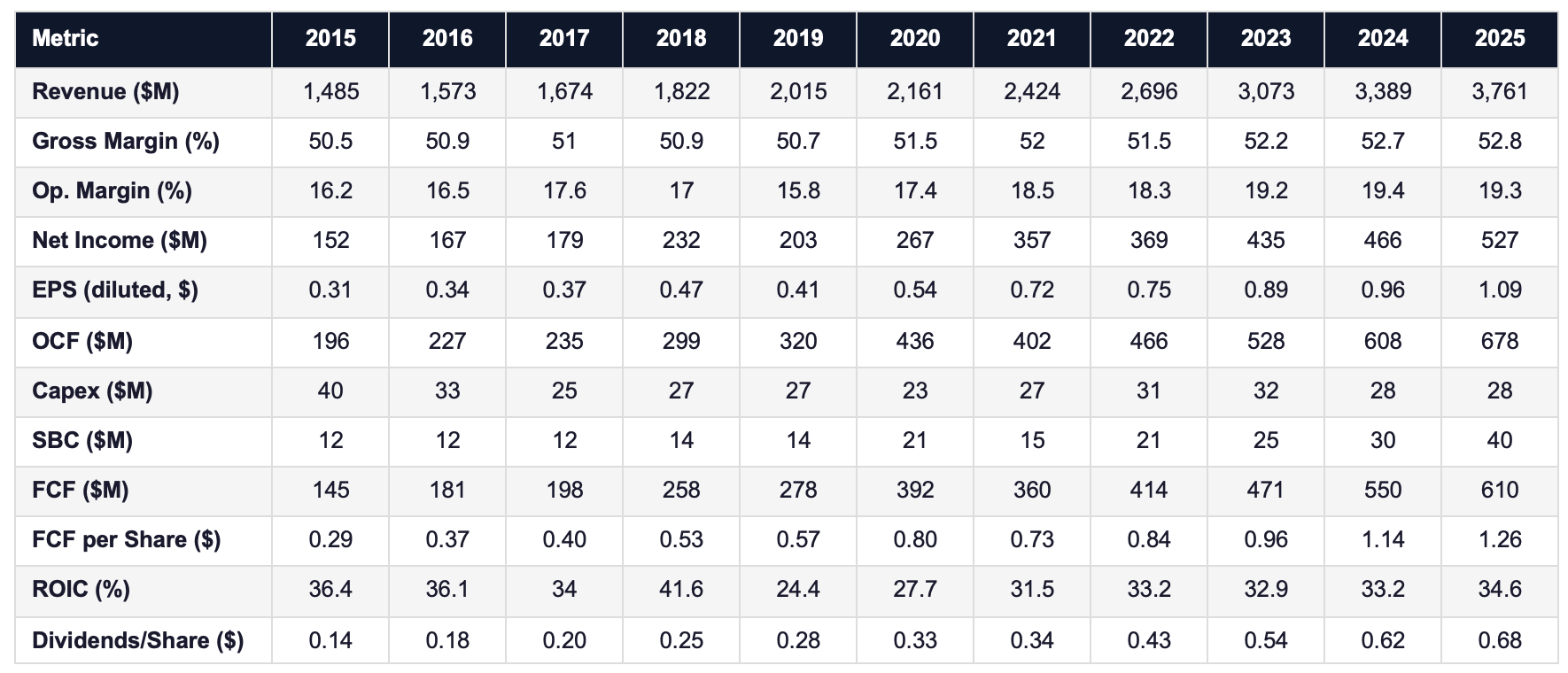
Total revenue grew 11% year over year in 2025, from $3.4 billion to $3.8 billion. Organic growth contributed 6.9 percentage points and acquisitions contributed the remaining 4.1 percentage points. Within that organic number, termite and ancillary grew 9.9%, the fastest of the three segments, and the one where pricing discipline is structurally highest: a customer facing a termite price increase must weigh it against losing the warranty entirely. Management guided for 7% to 8% organic growth in 2026. The ten-year compound annual growth rate from 2015 to 2025 was approximately 9.7%.
Gross margin has been remarkably stable across the decade, ranging between 50.5% and 52.8%, a signal that pricing discipline has consistently offset input cost inflation across every cycle the business has faced.
The 2019 operating margin compression from 17.0% in 2018 to 15.8% tells an important story. SG&A expanded aggressively as Rollins accelerated headcount, sales infrastructure, and acquisition activity, a deliberate decision to spend ahead of revenue. The compression was temporary, fully absorbed by 2021. By 2023 operating margins had reached 19.2%, exceeding any prior year in the decade, and by 2025 they stood at 19.3%.
Diluted EPS grew from $0.31 in 2015 to $1.09 in 2025, a compound annual rate of approximately 13%. The share count declined modestly from approximately 492 million to approximately 484 million over the decade, confirming that buybacks contributed almost nothing to the per-share growth. Operating margin expanded from 16.2% to 19.3% over the same period, and that expansion, compounding on a revenue base growing at nearly 10% annually, is what drove earnings per share higher.
4. Capital Allocation
Rollins generated $678 million in operating cash flow in 2025. That cash funded the acquisition program of $309.5 million and the full dividend payment of $327.9 million, with a modest surplus. The $200 million block share repurchase from the founding family and the broader acquisition activity across the year were funded in part by the $500 million in senior notes issued in February 2025, which replaced the revolving credit facility as the primary long-term debt instrument.
The acquisition program deployed $309.5 million in 2025, completing 22 acquisitions and 4 franchise buybacks. The largest was Saela Pest Control, acquired in April 2025 for $207.2 million, with management describing post-acquisition performance as exceeding expectations.
The Romex acquisition closed April 1, 2026 for $90 million plus $10 million of contingent consideration. Goodwill has grown from $250 million in 2015 to $1.37 billion at year-end 2025. That growth has not compressed ROIC. The returns on the operating assets of acquired businesses have held above the cost of capital across the decade.
Rollins paid $0.6775 per share in dividends during 2025, a total of $327.9 million. The dividend has been raised in every year of the past decade, growing from $0.14 per share in 2015 to $0.6775 in 2025, an increase of approximately 384% over ten years. The 2025 payout ratio against net income was approximately 62% and against FCF was approximately 54%.
Rollins does not run a consistent open-market repurchase program. It executed two block repurchases directly from the founding family through secondary offerings: 8.7 million shares for $300 million at $34.39 in September 2023, and 3.5 million shares for $200 million at $56.93 in November 2025. In the November 2025 transaction, LOR Inc. and Rollins Holding Company sold approximately 20 million shares at $57.50 in the public offering; Rollins repurchased 3.5 million of those shares at the underwriter price. The company received no proceeds from either offering. The diluted share count declined from approximately 492 million in 2015 to approximately 484 million in 2025, a reduction of less than 2% over a decade.
Capital expenditure was $28.1 million in 2025, or 0.7% of revenue. In February 2025 Rollins issued $500 million in ten-year senior notes at 5.25%, due February 2035, and in March 2025 established a $1 billion commercial paper program, of which $114.4 million was outstanding at year-end. The revolving credit facility of $1 billion was undrawn. Total financial debt at December 31, 2025 was approximately $624 million against operating cash flow of $678 million. At less than one time operating cash flow, the balance sheet carries no meaningful constraint on the acquisition program that drives most of the revenue growth.
5. Competition
Rollins operates in a fragmented market with low barriers to entry at the local level. Any licensed technician with a vehicle and a supply of chemicals can start a pest control business. The barriers to operating at scale are substantial: route density economics, brand recognition, proprietary technology, and the financial discipline to execute acquisitions at rational prices over decades are not characteristics that entry-level operators possess. The competitive landscape has three distinct layers.
Rentokil Initial
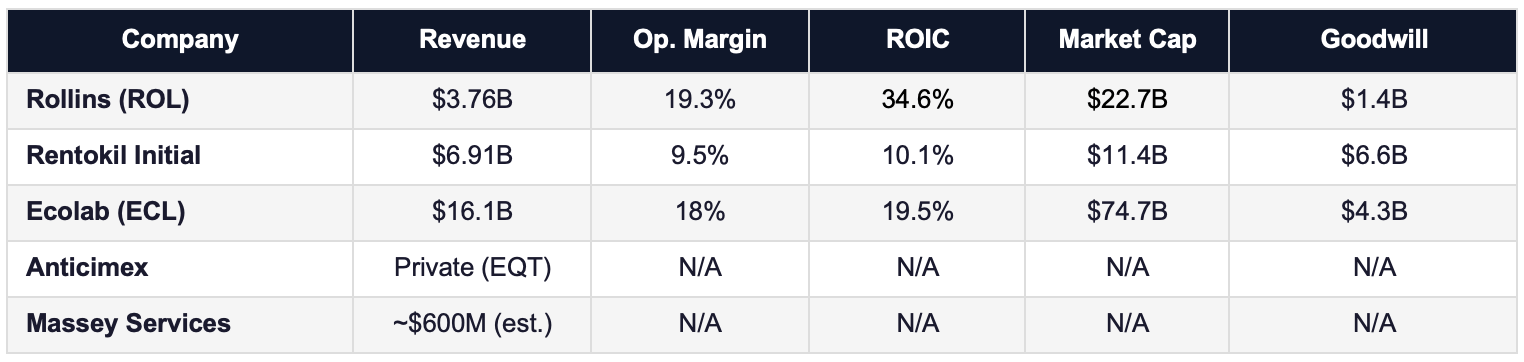
Rentokil is the only direct public peer comparable in business model and geographic reach. Before the Terminix acquisition, Rentokil’s ROIC was rising consistently, from 14.1% in 2015 to 28.6% in 2020 and 30.0% in 2021, as it executed a systematic European consolidation strategy that generated genuine returns. The $6.7 billion Terminix acquisition, which closed in 2022, reversed that trajectory abruptly. The acquired invested capital base expanded dramatically while integration complexity suppressed operating income, collapsing ROIC to 6.5% in 2022. By 2025 it stood at 10.1%, still less than a third of Rollins’s 34.6%.
The goodwill comparison tells the same story in a different register. Rentokil carries approximately $6.6 billion of goodwill against a market capitalisation of approximately $14.9 billion. Nearly half its market value is acquisition premium sitting on the balance sheet generating no cash. Rollins carries $1.4 billion of goodwill against a market capitalisation of approximately $22.7 billion at current prices, less than 7%. The difference is not simply that Rentokil made a large acquisition. It is that the premium paid has not yet been justified by the returns generated on the acquired assets. Rollins has spent two decades demonstrating that its acquisition premiums earn their cost. Rentokil is still working to demonstrate the same.
The operating margin comparison reinforces the picture. Rollins runs at 19.3%. Rentokil ran at 9.5% in 2025. That nearly 10 percentage point gap reflects route density economics, technician productivity, pricing discipline, and brand strength that Rentokil has not achieved at the same level. Three years after closing the Terminix transaction, Rentokil continues to manage integration complexity, customer attrition, and margin pressure in a business whose domestic economics have historically been weaker than Rollins’s. The Terminix acquisition was intended to create the world’s largest pest control operator by revenue. It achieved that goal. It has not, to date, translated into the operational economics that Rollins has demonstrated over decades.
Ecolab
Ecolab is a $16.1 billion diversified chemicals and services company whose businesses span institutional cleaning, water treatment, food safety, healthcare hygiene, and pest elimination. The pest division competes with Rollins primarily in large commercial and institutional accounts where pest service is bundled into a broader Ecolab relationship. Ecolab’s ROIC was 19.5% in 2025, meaningfully below Rollins’s 34.6% but a strong absolute result that reflects genuine competitive advantages across its core chemicals and services businesses. Ecolab is a formidable operator in the specific commercial and institutional segment where it concentrates, but its pest business is one division among many and it does not compete meaningfully with Rollins in residential, termite, or small commercial work.
Anticimex
Anticimex is a private Swedish operator owned by EQT Partners and the dominant pest control platform in Europe, with growing North American ambitions. No audited financial data is publicly available. Its strategic relevance is twofold: it represents direct competition in the international markets where Rollins is building, and it is the most logical future competitor for the North American acquisition targets that Rollins currently pursues with limited competition. The absence of public financials prevents any direct comparison, but Anticimex’s trajectory warrants monitoring.
Massey Services
Massey Services is a privately held, family-owned operator founded by Harvey L. Massey in 1985 and headquartered in Orlando, Florida, with estimated annual revenues of approximately $500 to $600 million. It is the most formidable regional independent in the Southeast, competing directly with Rollins’s Orkin and other brands in Florida and Georgia, which are among Rollins’s densest domestic markets. Massey competes for the same customers and technicians in its home markets and has built genuine brand recognition over four decades of operation. It also represents the archetypal succession opportunity: a well-run family business that will eventually face a transition decision, and for which Rollins would be among the most credible and operationally sensitive buyers.
The Fragmented Long Tail
The United States pest control market contains thousands of independent operators, most generating under $5 million in annual revenue. These businesses are not competitive threats to Rollins at the scale level. They are the raw material of the acquisition strategy. An independent operator competing against Rollins in any local market faces two structural disadvantages simultaneously: lower route density means higher cost per customer served, and lower purchasing volume means higher cost per chemical unit applied. Neither gap closes without the scale that only years of consolidation can produce. An estimated 75% to 80% of the domestic market remains outside the hands of the top national and regional operators, representing decades of acquisition runway for a disciplined consolidator.
6. Management
Jerry E. Gahlhoff Jr. — President and Chief Executive Officer
Jerry Gahlhoff has served as President and CEO since January 1, 2023. He joined Rollins in 2008 through the HomeTeam Pest Defense acquisition, not through the Orkin legacy or the founding family, and spent 24 years inside the organisation before assuming the top role. He holds a Master of Science in Entomology from the University of Florida.
Pest control is a technical business. The economics that make it attractive, recurring contracts, route density, termite warranties, rest on a service that must be delivered correctly by licensed technicians applying the right treatment to the right infestation. A CEO who understands the product at the entomological level understands why the route matters, why the technician retention rate matters, and why the warranty claim rate matters, in a way that a generalist manager does not.
Gahlhoff’s 2025 total compensation was $8.97 million. Base salary of $1.1 million represented approximately 12% of the total. The annual cash incentive of $1.68 million paid at 100% of target on the EBITDA element and 105% of target on the revenue element, reflecting 100.1% and 101.6% plan achievement respectively. Stock awards comprised $4.40 million in restricted stock and $1.73 million in performance share units tied to three-year revenue CAGR, adjusted EBITDA margin, and relative TSR against the S&P 500. The 2023 PSU cycle concluded at year-end 2025 with 11.7% three-year revenue CAGR and 22.6% average adjusted EBITDA margin, earning maximum payouts on both operating components.
Ownership and Governance
The Rollins family controls approximately 37.86% of shares outstanding through the Significant Shareholder Group, consisting of Gary W. Rollins, his niece Amy R. Kreisler, and the children of the late R. Randall Rollins: Pamela R. Rollins and Timothy C. Rollins. The primary holding vehicle is LOR Inc., which controls 152.2 million shares, or 31.58% of shares outstanding, through two voting trusts that each hold a 50% interest. Neither trust can direct LOR’s votes without the agreement of the other. The Vanguard Group holds 7.94% and BlackRock holds 5.92%.
Gary W. Rollins stepped back from his formal Board seat at the April 2026 Annual Meeting after 45 years of active involvement, remaining as a non-voting honorary Chairman Emeritus. Timothy C. Rollins, Gary’s nephew and Randall’s son, was elected to the Board at the same meeting. With Pamela R. Rollins already a Board member since 2015, the third generation now occupies two board seats.
The six-decade record is the most direct evidence of how family control has been exercised. Revenue has compounded from a single acquired business to $3.8 billion. ROIC has averaged above 30% for five consecutive years. The acquisition discipline that built the goodwill on the balance sheet has not compressed the returns on the operating assets beneath it. The concentrated control has served long-term shareholders well across this history.
The governance risk is not that the structure fails mechanically. The 50/50 voting trust split means no single family member or branch can act unilaterally, and the structure has held without visible disruption for over three decades. The risk is that the informal consensus-building that made it work under the founding generation becomes more difficult as the number of family members with independent interests grows across the third generation. Gary’s personal authority as the patriarch was a form of governance that voting trust documents alone cannot replicate.
7. Growth Levers & Addressable Market
The United States pest control market generates approximately $20 billion in annual revenue and remains deeply fragmented, with the top operators collectively controlling an estimated 20% to 25% of the total. Rollins generated $3.8 billion of that revenue in 2025. The remaining 75% to 80% is served by thousands of independent operators, most of whom lack the scale, the technology, and the succession plan to compete with a disciplined consolidator over a decade. The growth runway follows directly from that fragmentation.
Organic Price Increases
Rollins has demonstrated consistent ability to raise prices across its customer base. Organic revenue growth of 6.9% in 2025 and 6.6% in Q1 2026 reflects the combination of new customer additions and price increases on the existing base. In the termite segment, where the warranty creates a financial disincentive to cancel, price sensitivity is structurally lower than in discretionary service categories. Management has guided for 7% to 8% organic growth in 2026.
The key constraint on price increase capacity is technician quality and customer retention: customers absorb price increases when the service relationship is strong and do not when it is not. The people investment and the pricing power are not independent variables.
Cross-Selling to the Existing Customer Base
With average services per customer below 2.0 across a base of more than two million customers, the cross-selling opportunity does not require acquiring new territories or building new routes.
It requires a trained conversation on an existing visit. Moving from approximately 1.8 to 2.2 services per customer over five years would add approximately 22% to the revenue contribution from the existing base at near-zero incremental customer acquisition cost. Rollins added 14 dedicated commercial branches and 3 dedicated commercial regions in 2025 specifically to deepen the commercial services-per-customer ratio, and the commercial segment’s 7.6% organic growth is the early evidence of that investment producing results.
Acquisition of Independent Operators
The top operators collectively control an estimated 20% to 25% of a market generating approximately $20 billion in annual revenue domestically. The remaining 75% to 80% is served by thousands of independent family businesses facing a generational succession problem.
Management guided for 2% to 3% inorganic revenue contribution in 2026, consistent with a pace of acquisition activity that has been sustained for years. The pipeline of willing sellers is structural and long-duration.
Geographic and International Expansion
International operations contributed $269.7 million, approximately 7% of 2025 revenue, primarily from company-owned operations in Canada, Australia, the United Kingdom, and Singapore. The global pest control market is estimated at over $20 billion annually and is more fragmented internationally than domestically. Rollins’s acquisition playbook has been tested almost exclusively in North America.
The international opportunity is real but carries execution risk that domestic bolt-on acquisitions do not: different regulatory environments, different pest species requiring different treatment protocols, and different competitive landscapes all increase complexity. Management has been deliberately measured in international expansion, consistent with the operational discipline that characterises the domestic business.
Adjacent Services and the Ancillary Layer
The 10% of revenue currently classified as ancillary services is the highest-growth and highest-margin component of the mix. As crawlspace encapsulation, insulation, wildlife exclusion, and mosquito control grow as a share of the revenue mix, the overall margin profile improves structurally.
Fox and Saela were acquired in part because of their success in selling adjacent services to residential customers alongside core pest control. The cross-brand deployment of those capabilities across the Orkin network is a multi-year initiative still in early stages.
8. Valuation
Every price paid for a business contains an implicit question: how many years of future cash flows are already baked into what you are paying today? The Bearhold framework constructs a year-by-year series of discounted free cash flows and asks: at today’s stock price, how many years of future earnings are embedded? Everything the business earns beyond that point comes to you for free. The fewer the embedded years, the more of the future you receive without paying for it.
At approximately $47 per share, my model puts Rollins at approximately 28 years of embedded discounted cash flows. The zone is Stretched.
Businesses with Rollins’s profile, three quarters of revenue recurring, non-discretionary demand across the customer base, and ROIC consistently above 30%, have historically commanded premium valuations. Over the past decade Rollins has traded a far more stretched valuation than the 28 years recorded at the time of this report. At $47 the implied number of embedded years of cashflow is the lowest it has been in ten years. The Stretched designation reflects where the embedded years framework places the current price. The historical context is that this business has rarely been available at this valuation.
For a detailed explanation of how this valuation framework works and the thinking behind it, please check A Comprehensive Guide to Business Valuation
9. Risks
Labor Cost and Technician Retention
Employee expenses at cost of services represented 31% of revenue in 2025, the single largest cost line in the business. Rollins is a people business. Every customer interaction is delivered by a licensed technician who cannot be automated away.
When labor markets tighten, wage inflation runs through the cost structure immediately.
Management acknowledged in 2025 that retention of newer team members, particularly those in their first six months, remains an area requiring improvement. A technician who leaves carries route knowledge and customer relationships that take time and cost to replace.
Acquisition Execution Risk
Each of the 94 acquisitions completed over three years requires customer integration, technician onboarding, technology migration, and retention management through the transition. If integration quality deteriorates as acquisition velocity increases, acquired customer attrition rises and the return on deployed acquisition capital falls.
The FTC inquiry into Rollins’s post-employment non-compete practices adds a secondary dimension: if the FTC compels a significant narrowing of these restrictive covenant agreements, the cost of retaining trained technicians and protecting the customer relationships acquired at premium prices may increase.
Separately, Rollins faces ongoing litigation under California’s Private Attorneys General Act related to employment practices at its California operations, which contributed approximately 11% of 2025 revenues. Management does not expect either matter to be material, but both carry uncertainty that warrants monitoring.
Governance Transition
The transition from Gary W. Rollins’s active leadership to the third generation of family stewardship is the governance risk I carry explicitly rather than minimise. Gary spent over 45 years building and running this business. The discipline, the acquisition culture, the people philosophy, and the capital allocation framework that produced the decade-long financial record belong to his generation of leadership.
The voting trust structure requires consensus between Gary’s branch and Randall’s three children. What made that consensus durable under the second generation was a combination of shared personal history, Gary’s demonstrated results, and the informal authority of a patriarch still actively present in the business. That combination is now changing. The structure holds. The question is whether the culture it encased holds equally well.
Insurance and Claims Costs
Rollins retains a substantial layer of general liability, workers’ compensation, and auto liability risk through a high-deductible insurance program. At December 31, 2025, total accrued insurance liabilities were $123 million, and the company maintained $82.4 million in letters of credit as security for these obligations under its insurance carrier agreements. Insurance and claims costs at cost of services ran at 1.8% of revenue in 2025, down 20 basis points from 2024, but this line is volatile. Q1 2026 saw higher insurance and claims costs as a specific driver of operating margin compression.
10. The Verdict
Rollins is Approved on the strength of a route-based recurring service platform that has demonstrated genuine structural durability across a full economic cycle and through conditions that would have exposed a weaker franchise.
The case rests on three things. The economics of the underlying model. The financial record that validates those economics across a full cycle. And the structural durability of the competitive position under conditions that compressed the margins of every comparable service business.
The economics are genuine. A route-based recurring service business whose primary demand driver is the financial irrationality of cancellation, whose capital expenditure runs at 0.7% of revenue, whose gross margin has held between 50% and 53% for a decade without interruption, and whose operating assets generate returns above 34% is not a business whose qualities are explained by management skill alone. The model is structurally sound at its foundation. O. Wayne Rollins recognised it in 1964. The sixty years of compounding since then are the output of a correct original insight applied with consistent discipline by three generations of stewardship.
The financial record is the empirical case. ROIC compressed from 36.4% in 2015 to 24.4% in 2019 when acquisition spending accelerated faster than operating profit, yet remained more than 19 percentage points above the cost of capital even at that trough. By 2025 ROIC stood at 34.6% against a WACC of 8.5%, a spread of 26 percentage points.
Operating margins expanded from 16.2% to 19.3% over the decade, with the adjusted margin reaching 20% once acquisition-related amortisation is stripped out. FCF per share grew at approximately 16% compounded over ten years, almost entirely fundamental.
The risks are real and have been stated plainly. Labor cost and insurance claims volatility are the most immediate operational watch items, both evidenced clearly in the Q1 2026 results. The governance transition from Gary W. Rollins to the third generation introduces uncertainty that voting trust documents alone cannot resolve. None of these risks, assessed honestly against what has been built over sixty years, changes the Approved designation.
Q2 2026 (reported July 22, 2026)
Revenue increased 7.9% to $1.08 billion, with organic revenue up 5.7%.
Operating margin declined 110 basis points to 18.7%, and adjusted operating margin declined the same amount to 19.5%, as demand softened in residential pest control, specifically among brands more reliant on consumer-initiated, digital-driven demand, while relationship-based channels like home builders and door-to-door sales continued to grow.
Adjusted EPS rose 6.7% to $0.32. Free cash flow declined 1.2% to $166 million for the quarter, with acquisitions ($117 million) continuing to be the primary use of capital, alongside $88 million in dividends.
Management stated plainly that results and margins came in below their own expectations, attributing the shortfall to a cost structure positioned for a stronger growth environment than materialized, and outlined organizational and operational changes now underway to improve local execution and better align resources with current demand.
I read this quarter as a genuine demand and execution miss, but not a structural one. The softness is concentrated in a specific, identifiable channel, consumer-initiated residential demand, while the Company's relationship-based channels, home builders and door-to-door, continued to grow, which tells me this isn't a broad-based erosion in the business's competitive position.
Management's own language points to a cost base that outran demand, an internal, correctable issue, rather than pricing pressure, market share loss, or a weakening moat.
Nothing in this release changes my underlying view of the business in the long run.
Q1 2026 Update
Total revenue of $906.4 million grew 10.2%, with organic growth of 6.6%. Residential organic growth was 4.2%, commercial 7.7%, and termite and ancillary 9.8%, all consistent with the full-year 2025 trajectory. Operating margin fell 120 basis points year-over-year to 16.1%, driven by weather-suppressed one-time service volumes in January and February alongside higher fleet, insurance, and selling costs. Management noted that March recovered strongly, with approximately 12% total revenue growth and over 8% organic growth as conditions normalised. The quarterly results introduce no new concerns about the underlying thesis.
Disclosure update: The author now holds a position in Rollins. The position was initiated after the original publication date of this report. All analysis and conclusions remain unchanged. This report reflects the author’s personal views and is not investment advice. Investing carries the risk of permanent capital loss. Read the full disclaimer here
