



Adobe is, on almost every conventional measure, one of the better businesses in software. It carries gross margins near 90 percent, converts more than 40 cents of every revenue dollar into free cash flow, has grown revenue every year for well over a decade, and sits on top of a Creative Cloud franchise that remains the default toolset for professional creative work worldwide.
The stock has also pulled back meaningfully over the past several years, and on a simple extrapolation of its own five-year free cash flow growth rate, Adobe screens as genuinely cheap today relative to almost anything comparable in software. Judged purely on the business Adobe has been for the last decade, and the price it trades at today, this looks like an easy buy.
The stock has been beaten down, and the headlines since have mostly been arguments about what that beating down means. One camp reads it as noise; the moat described later in this report, the workflow lock in, the indemnification, the installed base, is strong enough to absorb whatever generative AI throws at Adobe, seat contraction included, and the business that comes out the other side looks close enough to the business that went in. The other camp reads it as signal; that generative AI does something structurally different to Adobe than any prior disruption, that the story effectively ends here, and that the Adobe of the next five years does not resemble the Adobe of the last five no matter how strong today’s moat looks on paper. I am not writing this from inside either camp. I am examining both claims against the actual disclosure available and trying to arrive at a rational conclusion; whether this is a clear buy, a clear pass, or something genuinely too uncertain to call.
The author does not hold a position in Adobe, Inc. at the time of publication. This report reflects the author’s personal views and is not investment advice. Investing carries the risk of permanent capital loss. Read full disclosure here.
1. The Business
What it Does
Adobe builds the software stack that creative, marketing and document heavy work runs on: Creative Cloud Pro (Photoshop, Illustrator, Premiere Pro, After Effects, Lightroom, Substance 3D), Acrobat and Acrobat Studio for document productivity, Adobe Express for quick turn content, and Adobe Experience Platform and GenStudio for enterprise marketing execution.
Generative AI is delivered primarily through Adobe’s own Firefly family of models, but Firefly is not the only option inside Adobe’s apps. Within Photoshop, the Firefly app and a growing number of other surfaces, customers can also choose from an expanding roster of third party partner models built by other AI labs, generating and editing content without ever leaving Adobe’s interface.
Firefly itself is sold both embedded inside subscriptions and standalone through the Firefly app, Firefly Services and Firefly Foundry. In November 2025 the company agreed to acquire Semrush, a brand visibility and SEO platform, for approximately $1.9 billion in cash. The deal closed in the first half of fiscal 2026 and was already contributing roughly $480 million of ARR by the second quarter.
How the Company Makes Money
Revenue is overwhelmingly subscription based, 96 percent of fiscal 2025 revenue, recognized ratably over contract terms that typically run one to thirty six months. Historically this has meant per seat licensing. An individual, a team, an enterprise buys access for a named user, and that is the whole model.
Creative Cloud and Firefly plans now bundle a fixed monthly allotment of generative credits on top of that. Those credits get consumed whether the customer generates output with Firefly or with one of the partner models available inside the same application. Adobe collects a toll either way. I think that is an important nuance, and I come back to it in the Moat section, because it means Adobe monetizes usage of its competitors’ models as well as its own, distinct from Firefly Services, the separate enterprise API business it sells directly for automated content generation at scale.
Management has begun disclosing an AI first ARR line separately from the legacy subscription base. The company says it tripled year over year to exceed $500 million as of the second quarter of fiscal 2026. That is real growth. It is also worth sizing against a roughly $27 billion total ARR base. Still a small fraction of the whole. Not yet a second engine.
Segments and Reporting
Fiscal 2025 was reported across three segments. Digital Media did $17.65 billion in revenue, up 11 percent. Digital Experience did $5.86 billion, up 9 percent. The legacy Publishing and Advertising business did $256 million, down 7 percent, and took a $70 million non cash goodwill impairment in the second quarter of fiscal 2026.
In the first and second quarters of fiscal 2026 Adobe introduced a new categorization, Business Professionals and Consumers, or BPC, to group knowledge-worker-facing tools like Acrobat AI Assistant and Adobe Express together for internal tracking and go to market purposes. I think that reclustering is worth watching in its own right, since it looks like the lens management is using to think about the casual, lower switching cost side of its customer base discussed in the Moat section.
Scale and Footprint
Adobe employed 31,360 people at the end of fiscal 2025, roughly split evenly between the United States and international locations, with large development centers in Bangalore and Noida, India. The company operates a hybrid work model and reported 9.9 percent total attrition for the year. Corporate headquarters remain in San Jose, California.
2. The Moat
I see Adobe’s moat resting on three pillars discussed as follows:
1. The Interface and Workflow Moat
Commercial creative production runs on local canvas control, layer based non destructive editing, timeline orchestration and plugin ecosystems that a single prompt to image or prompt to video model does not replicate on its own. An agency producing a client deliverable needs to take a rough concept through revisions, client feedback, color correction and final packaging as a layered, editable file that another editor can pick up months later, not a flattened image generated in one shot.
Photoshop’s layer stack, Premiere Pro’s timeline and multi camera workflow, and Illustrator’s vector editing model are specific, learned skill sets that an entire generation of working designers, video editors and illustrators trained on, and that agencies and in house creative teams have built their production pipelines, file formats and quality control processes around. Ripping out that stack in favor of a cheaper or even a better performing standalone generative model means retraining staff, rebuilding pipelines and renegotiating client delivery formats, a cost that sits on top of and separate from whatever the new tool itself costs.
This is also where Adobe’s decision to plug competing AI models directly into its own interface matters more than it might first appear. Adobe does not force customers to choose only Firefly. Within several of its applications, customers can select from Adobe’s own Firefly models alongside an expanding roster of third party partner models, generating and editing inside the same Photoshop, Premiere or Firefly app canvas regardless of which underlying model actually produced the output.
That is a genuinely different competitive posture than most software incumbents facing a foundation model threat have taken. Rather than treating outside models purely as competition to be out built, Adobe is positioning its own interface as the neutral surface where any model’s output gets refined, layered and delivered into a finished, brand safe asset.
If a customer’s favorite generative model changes next year, or a new lab releases something better, Adobe’s bet is that the customer stays inside Adobe’s canvas and simply points it at a different model, rather than leaving Adobe altogether. I think this meaningfully lowers the risk that a single superior foundation model from OpenAI, Google or another lab pulls creative professionals away from Adobe wholesale, though it does mean Adobe is also giving up some of the pricing power it might otherwise have captured if Firefly were the only option inside its own apps.
There is a second, more literal kind of lock in sitting underneath the interface argument, the file format itself. A .psd file with fifty layers, built up over years of campaign work. A .ai vector file with a full history of edits. A .prproj timeline with linked media, color grades and multi camera sync.
These are not portable formats. An agency that needs to revise a client’s three year old campaign asset cannot open that history in a text to image prompt tool. It has to open it in Photoshop, or Illustrator, or Premiere, because that is the only software that reads the file the way it was built. Ripping Adobe out means either abandoning that historical asset library or paying to convert terabytes of legacy project files into something a different tool can read, and I think that cost is separate from, and in some ways harder to shake than, the muscle memory argument above.
2. Commercially Safe Data and IP Indemnification
Firefly is trained on Adobe Stock’s licensed library and public domain content, which allows Adobe to offer enterprise customers intellectual property indemnification on Firefly generated output through certain enterprise and teams plans. For a Fortune 500 marketing or legal department, that indemnification is frequently the deciding factor in whether generative AI can be used in a public facing campaign at all. A chief marketing officer who greenlights the use of an ungoverned or scraped data model in an ad campaign is personally exposed if that campaign later becomes the subject of a copyright claim, and general counsel at large enterprises have become considerably more conservative about this exposure as litigation against several open source and general purpose foundation model providers continues to work through the courts. Adobe’s indemnification effectively transfers that legal risk away from the customer’s own legal department.
3. Ecosystem and Enterprise Lock In
Creative Cloud bundling, GenStudio’s bridge between creative production and marketing execution, Adobe Stock’s asset library, and now Semrush’s SEO and content visibility layer alongside the newly launched Adobe LLM Optimizer, aimed at brand visibility inside AI powered search, all extend the surface area a customer has to walk away from simultaneously in order to leave.
A large installed base of professionals trained specifically on Adobe’s tools, a certification and training ecosystem built around those tools, and a network of systems integrators and agencies whose own businesses are built around implementing Adobe products, all reinforce the switching cost independent of any single product’s own merits. This is the pillar I think is most exposed to erosion at the margin, and I want to spend a moment on where that erosion is actually most likely to show up.
There is also a layer of lock in that has nothing to do with what individual designers prefer, it cuts against the seat contraction argument in a way worth weighing. Large enterprises do not buy Adobe seat by seat. They buy through Enterprise Term License Agreements, administered centrally through the Adobe Admin Console, with unified billing and security compliance built around SAML and single sign on. An individual designer who would rather use a lightweight, standalone AI tool for a specific task still has to get that tool past the same IT department that negotiated the Adobe ETLA and does not want to manage security review, billing and access control for a dozen fragmented, unvetted AI startups on top of it.
I think this means Adobe’s enterprise revenue base is protected by procurement and IT inertia for longer than a pure count of how many designers still prefer Adobe’s tools would suggest, and it is worth weighing against the seat contraction risk in the Outlook section. It does not eliminate that risk. A large enough shift in how much output a given number of seats can produce still shows up eventually, admin console or not. But it probably slows how fast it shows up, and slower is a meaningfully different risk than fast.
Where the Moat Is Weakest: Casual Users Versus Professional and Institutional Clients
Not every Adobe customer faces the same switching cost, and I think it matters to separate the two customer groups Adobe itself now reports around. Business Professionals and Consumers, the audience for Acrobat and Adobe Express, are disproportionately casual users; A small business owner creating social graphics. A student annotating a PDF. An individual using Acrobat Sign to sign a document occasionally. These users have comparatively little invested in any particular tool’s specific workflow, often started on a free or low cost tier in the first place, and face a wide field of genuinely adequate free or near free alternatives, Canva chief among them, alongside a growing set of AI native tools that can produce a passable social graphic or summarize a document without touching an Adobe product at all.
I think this segment is the one most exposed to outright substitution the moment a free or materially cheaper alternative reaches good enough quality, because the switching cost for a casual user is close to zero. There is no institutional workflow to rebuild, no client delivery format to renegotiate, no certification to retrain.
Creative and Marketing Professionals, the audience for Creative Cloud’s flagship apps and for GenStudio, sit at the opposite end of that spectrum. These are institutional customers with production pipelines built around specific file formats, brand governance requirements, indemnification needs and, often, multi year enterprise agreements.
A professional colorist, video editor or brand design team is not making a casual, one off purchase decision the way a consumer choosing between a free app and a five dollar app is. I think this is precisely why Adobe’s enterprise and professional revenue has proven far stickier than a simple read of consumer software competition would suggest.
Competitive Landscape
Adobe’s competitive set spans several distinct fronts, and I think it matters to sort them the same way I sorted Adobe’s own customer base above, because the threat each poses is different depending on which side of that line it sits on.
On the casual and prosumer side, Canva remains the clearest threat; a free or low cost, browser based tool that has never required any of the workflow investment Creative Cloud demands, and one that is increasingly credible even for small business and social content use cases that used to default to Photoshop or Express.
Canva’s ownership of Affinity extends that reach to one time purchase, no subscription creative tools aimed at freelancers and hobbyists who specifically want to avoid a recurring fee, a positioning that speaks directly to the price sensitive, low switching cost segment I flagged in the Moat section.
A number of the foundation model native tools, particularly consumer facing image generators like Midjourney and the free or low cost tiers of OpenAI’s and Google’s own generative products, compete on this same casual end today; a hobbyist or social media manager generating a one off image has essentially no reason to open Photoshop first.
On the professional and institutional side, the picture looks different. Figma is the clearest example; despite sitting in the same broad design category as Illustrator, Figma competes almost entirely for institutional product design and UI/UX teams inside enterprises, not casual users, and it remains independent after the terminated 2023 merger agreement, for which Adobe paid a $1 billion termination fee in fiscal 2024.
HubSpot, Ahrefs and other marketing and SEO point solutions competing with the newly acquired Semrush are similarly business tools sold into marketing departments. And the same foundation model labs competing casually through consumer apps, OpenAI and Google chief among them, are simultaneously building enterprise API and licensing businesses aimed at the exact large, brand governed customers Adobe’s indemnification pitch is built to hold onto, meaning they are pushing upmarket on the professional front at the same time they compete downmarket on the casual one.
No single competitor matches Adobe’s combination of workflow depth, enterprise indemnification and installed base on the professional and institutional side, which is where I think Adobe’s moat is genuinely strongest. But the casual side is where the credible fronts have multiplied fastest, and the number of fronts Adobe has to defend simultaneously across both ends of that spectrum has grown over the past years.
3. Financial Performance
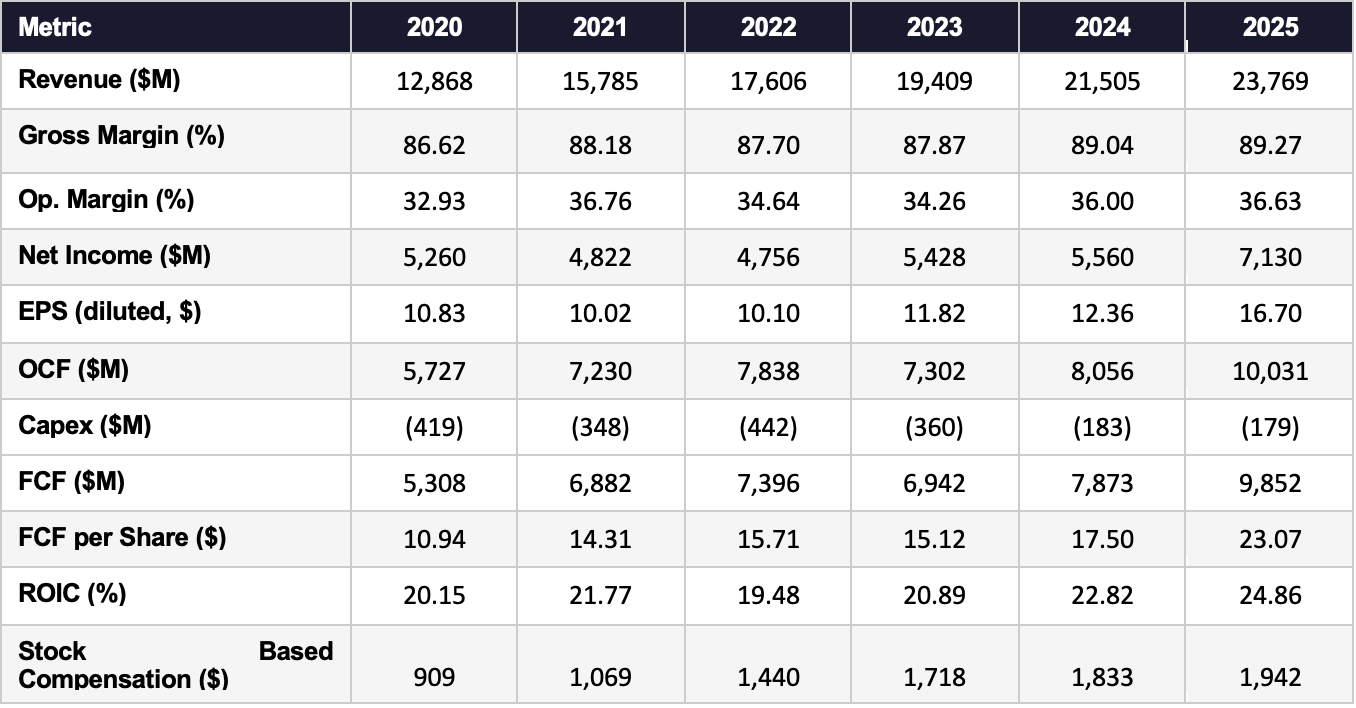
There is not much to relitigate about the historical numbers, and I do not want to spend this report doing so. The five year record is, on its face, impressive; revenue compounded from $12.87 billion in fiscal 2020 to $23.77 billion in fiscal 2025, gross margin held near 90% throughout, net income grew to $7.13 billion in fiscal 2025, up 28% Y-O-Y, and free cash flow reached $9.85 billion, a margin above 40%. Diluted EPS grew from $10.83 to $16.70 over the same window, helped by a buyback program that cut the diluted share count from 485 million to roughly 402 million. ROIC improved from about 20% to nearly 25% across the period. None of this is in dispute, and none of it is really what this report is about.
The point of this report is not to re confirm a clean historical trend. It is to stress test whether the next several years look anything like the last five, and I do not think they do. Generative AI changes the relationship between headcount, seats and output in a way that has no precedent in Adobe’s own history, which means extrapolating the trailing growth rate forward is exactly the wrong instinct here. The rest of this report, particularly the Outlook section, is my attempt to explain why.
4. Management
A Leadership Transition That Lands at the Wrong Moment
Shantanu Narayen announced on March 12, 2026 that he intends to step down as CEO once a successor is named, after eighteen years in the role, and will remain as Chair of the Board once that transition completes. As of this writing, no successor has been named. A special committee led by Frank Calderoni, Adobe’s Lead Independent Director, is running the search across both internal candidates, David Wadhwani, President of the Creativity and Productivity Business, is widely described as the likely internal front runner, with Anil Chakravarthy, President of the Customer Experience Orchestration Business, also mentioned, and external candidates, reportedly including AI first leaders from outside the company. Narayen remains CEO today, meaning Adobe is running an open ended succession process in parallel with everything else in this report.
Layered on top of that, CFO Dan Durn departed abruptly on June 15, 2026 for Marvell Technology, where he had already served as a board member prior to his departure. Steve Day, a twenty year Adobe finance veteran and SVP of Corporate Finance, was installed as interim CFO effective the same day and reports directly to the CEO. As of this writing Day remains interim, with no permanent CFO named.
Capital Allocation
The Board’s $25 billion repurchase authorization runs through March 2028, and Adobe spent $11.28 billion of it in fiscal 2025 alone, a pace that would exhaust the remaining authority well before the deadline if sustained. Stock based compensation was $1.94 billion in fiscal 2025 with $3.24 billion unrecognized over a 2.19 year weighted average period, meaning a real share of the buyback program is offsetting dilution from the compensation program.
Outstanding senior notes rose from $5.65 billion to $6.15 billion at par during fiscal 2025, and Adobe entered interest rate swaps converting a portion of that fixed rate debt to floating. Buybacks at this pace are increasingly assisted by debt issuance and are not funded purely out of free cash flow. None of this is alarming on its own for a company generating the free cash flow Adobe generates, but it does mean the EPS growth discussed in the Financial Performance section is not purely an organic story.
5. Outlook
This is the section I would ask a reader to actually sit with, because the standard way to model a name like this, grow revenue at a steady mid to high single digit rate, hold margins roughly flat, assumes a stability in Adobe’s unit of monetization that I do not think currently exists.
I want to walk through the scenario tree as I actually see it, with the pros, cons and genuine uncertainty left in.
Start with what I would call the seat problem. Generative tools compress the historical link between headcount and creative output. An agency or in house marketing team using Firefly, partner models, GenStudio and Acrobat AI Assistant can plausibly produce the same volume of images, video and documents with fewer entry level designers and production staff than it needed two or three years ago.
If that holds at scale across Adobe’s own customer base, the number of paid seats a given enterprise needs could shrink over time, and Adobe’s own AI is one of the tools accelerating that shrinkage inside its own installed base, which is the uncomfortable part.
Management’s stated answer is Generative Credits; monetize the same customer on compute consumed rather than headcount employed. In principle this could work. If seat count contracts while credit consumption expands to fill the gap, Adobe could hold or even grow revenue per customer even as the seat count itself falls. This is what the AI first ARR line is meant to capture, and it has tripled year over year to exceed $500 million as of the second quarter of fiscal 2026. That is genuine growth. It is also still roughly 2 percent of total ARR, nowhere near the scale that would need to be reached to offset outright legacy seat attrition if that attrition turns out to be significant.
Then there is what I would call the Value Deflation problem. The cost of AI inference, the compute behind every generated image, video or document, keeps falling as models get more efficient and the underlying hardware gets cheaper. In isolation, that is good for Adobe’s margin on the credits it sells. But Adobe does not set AI pricing in a vacuum. It competes for the same wallet against Canva, Affinity and a wide field of open source and API native tools facing the identical falling cost curve, most of which have far less legacy subscription revenue to protect and are correspondingly more willing to pass the savings straight through as lower prices.
If Adobe holds its credit pricing while competitors cut theirs, it risks losing the consumption dollars elsewhere. If Adobe cuts its own pricing to stay competitive, the consumption revenue that was supposed to backfill the lost seat revenue shrinks in dollar terms even as usage volume climbs. Either path could land Adobe back close to where the seat problem started; a shrinking seat base sitting on top of a consumption layer that is not growing in dollars fast enough to cover the gap. I want to be clear this is one plausible path among several, not a certainty, but it is exactly the kind of two sided cost dynamic that makes me unwilling to model consumption revenue with real confidence in either direction.
There is a cleaner sounding fix that gets raised in the market; price on the outcome the software helps produce, campaign performance or engagement or conversion, not on seats or raw compute. I do not think this actually resolves the problem. Isolating how much of a marketing outcome came from Adobe’s tools versus the client’s own creative strategy, media spend and brand equity is not something either side can cleanly measure, and a pricing model built on a number neither party can verify tends not to survive real contract negotiation.
Even setting that aside, outcome based revenue would track the marketing success of Adobe’s customers not Adobe’s own execution, meaning Adobe’s reported revenue would start moving with the ad campaigns, budgets and business cycles of thousands of unrelated companies rather than anything Adobe directly controls. That is a source of revenue volatility I do not think the market currently prices into a stock that has traded for years on smooth, highly predictable subscription revenue, and I would expect Wall Street to penalize the loss of that predictability.
My own guess, and I want to flag it as exactly that, a guess, is that if Adobe moves in this direction at all, it lands on some hybrid of a smaller fixed subscription floor plus a variable consumption or outcome layer on top, not a full jump to either pure metering or pure outcome based pricing. But I do not know, and I do not think Adobe’s own management knows yet either, what that split would look like; whether the variable piece ends up larger or smaller than today’s subscription base, how procurement departments used to fixed software budgets react to a variable line item, or what the resulting mix does to the ARR growth rate the market has spent years underwriting.
It could turn out that the consumption and outcome layers together add up to more revenue per customer than the seats they replace, in which case this entire risk resolves favorably and this report will have been too cautious. It could just as easily turn out smaller. I do not think this is resolvable from outside the company with the disclosure currently available, and I would treat anyone who claims to know with confidence which way it breaks as guessing dressed up as analysis.
There is also a regulatory constraint sitting on top of all of this that I think is easy to overlook. The Department of Justice filed a civil complaint against Adobe in June 2024 alleging violations of the Restore Online Shoppers’ Confidence Act, tied specifically to how Adobe discloses subscription terms and how easy or difficult it makes cancellation. Adobe’s motion to dismiss was denied in May 2025, and the case remains in discovery.
I raise it here because it lands directly on top of the pricing question this section is about. Whatever hybrid of fixed subscription and variable consumption or outcome based pricing Adobe eventually settles on will itself have to be disclosed and unwound in a way that satisfies the same regulatory standard currently being litigated, and a company under active scrutiny for how clearly it presents subscription terms and cancellation mechanics has less room to experiment with a more complex, harder to explain pricing structure than one operating without that overhang.
6. Valuation
Running the standard two engine framework, fundamental free cash flow per share compounding plus any change in the valuation the market assigns, on Adobe’s own trailing record, the stock screens as undervalued today. Free cash flow per share grew from roughly $10.94 in fiscal 2020 to $23.07 in fiscal 2025, a compound rate in the mid teens, funded partly by real cash flow growth and partly by the buyback program that cut the diluted share count from 485 million to about 402 million over the same period. At a price near $225, against that trailing growth rate and a business still generating a free cash flow margin above 40 percent, a straightforward extrapolation of the last five years forward would put Adobe in objectively cheap territory relative to its own history and against most software peers on a growth adjusted basis.
I do not think that extrapolation is the one to trust, and that is the entire reason I am not willing to call this attractive. The free cash flow growth rate I would need to extrapolate assumes the monetization model of the last five years, a largely fixed, predictable per seat subscription engine, carries forward roughly intact. Everything in the Outlook section above is about why I do not think that assumption is safe to make right now. If the seat base holds up and Generative Credits genuinely add revenue on top rather than merely replacing what seats used to generate, Adobe at today’s price is probably attractive, and by a meaningful margin.
If seat contraction runs ahead of credit monetization, or credit pricing gets competed down before it scales, the growth rate that makes today’s price look cheap simply does not materialize, and the market’s current valuation could turn out entirely appropriate, or the market could still be too generous even now.
7. The Verdict
This is not a business I think is broken today. Revenue, ARR, margins and free cash flow all look like a company executing well against the model it has run for years, and the moat around its existing seat base, workflow depth and IP indemnification remains genuinely strong.
My verdict is Pass, because too much of the next five years rests on questions this report cannot answer with the disclosure currently available; whether generative AI nets out to a shrinking or expanding revenue base per customer, whether whatever pricing model emerges from that shift is one the market will reward with anything close to today’s valuation, and who will actually be running the company and its finance organization by the time those decisions get made. I would rather pass on a name I cannot underwrite with real confidence than force a valuation call on top of the unknowns I have just spent this report laying out.
I do not think this resolves quickly. A pricing model transition of this scale, layered on top of an open ended leadership search, is the kind of thing that plays out over years. Consequently, I choose to remain on the sidelines until the company delivers consistent positive net seat expansion alongside a stabilized, predictable pricing framework under stable leadership.
The author does not hold a position in Adobe, Inc. at the time of publication. This report reflects the author’s personal views and is not investment advice. Investing carries the risk of permanent capital loss. Read full disclosure here.
my one takeaway from this report was that since i am technologically illiterate ai should stir away from anything i do not understand so i agree with your pass verdict